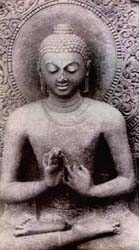
Unlike the Masters so far discussed, the Buddha is a figure from antiquity. The details of his life are uncertain for this reason, and also because histories in India were not recorded in the more factual way found in the West. As the founder of what is now a world religion comprising many different strands, his life has been the subject of an inevitable mythologising. The essential features of his life as far as we can tell include his birth as prince Siddhartha Gautama to the Sakya clan in India in the sixth century BCE; his leaving home to search for enlightenment; his attainment and subsequent bearing of the title 'Buddha'; and a period of about forty years of teaching as a wandering mendicant. He attracted a large following which he organised into a 'sangha' or spiritual community, the rules for which guide such communities to the present day.
Details of the Buddha's life are recorded in a haphazard way in a collection of texts known as the Pali canon, so-called because they were first written in that language. This is a vast collection of writings which were originally handed down orally, and scholars to this day are working on the relative authenticity of the different texts. The Pali canon is the basis of the Therevada tradition of Buddhism which claims to be closest to the Buddha's teachings (known as the Dhamma, or Dharma). A later offshoot, called the Mahayana, disputes this claim and recasts the teachings with a greater emphasis on elements such as compassion and emptiness, also introducing a host of deities confusingly called 'buddhas' which symbolise aspects of the teaching. Accounts of the Buddha in the Mahayana tend to be more symbolic, so scholars agree that an attempt at an historical portrait of the Buddha are better constructed from the Pali canon.
One aspect of the Buddha's personality that stands out in the Pali canon is the impact that he had on all those who came across him. According to the texts, they all exclaim something like the following after their conversion:
"Magnificent, Master Gotama! Magnificent, Master Gotama! Master Gotama has made the Dhamma clear in many ways, as though he were turning upright what had been overthrown, revealing what was hidden, showing the way to one who was lost, or holding up a lamp in the dark for those with eyesight to see forms. I go to Master Gotama for refuge and to the Dhamma and to the Sangha of bikkhus."
It is implausible that each new convert would recite such a formula, as it is that the men and women of the Elders' verses would all remember their past lives at the same point in their awakening, but despite these formalisms that dominate the texts there are many convincing dialogues and personal accounts to be found. One is left in no doubt that the Buddha's presence, force of personality, and skill in debate and metaphor had an extraordinary effect on his audience, and that many were inspired by him to attain the same heights of spiritual awareness.
The Buddha's teachings would probably have remained obscure as many other great teachers, but for the fact that they were adopted by King Asoka as the religion of his expanding empire one or two hundred years after the Buddha's death. Much like for Constantine or the founder of the Russian empire, there were a number of competing sects, any one of which could have been chosen by Asoka as a way of binding together territories containing many races and traditions. Asoka was impressed by the pacifism of the Buddha's message however, and in promoting Buddhism he made sure that this element was honoured. He also made sure that Buddhism adapted to local religious traditions, which had the historical effect of making the religion a very broad church indeed.
The Buddha's teachings are represented in slightly different ways in the different traditions, but are the epitome of a teaching of transcendence. Thoughts, feelings and perceptions are to be transcended by knowing them as they arise, as they are present, and as they disappear. It is not entirely clear whether one's ties to sense pleasures are first to be cut so that the necessary awareness can arise, or whether by practising the necessary awareness the ties to the sense pleasures are cut. Either way all attachments to the world are transcended and one eventually enters the state of nirvana, the cessation of all becoming. The key issue for the Buddha in his own search, and in his subsequent teachings, seems to have been that of impermanence. By recognising that all suffering arises from the impermanence of the material condition one is motivated to seek out the deathless, the stainless. This idea became enshrined as the Buddha's first Noble Truth.
The teachings of the Buddha are often represented in a systematic form, for example the Four Noble Truths, the Noble Eightfold Path, and the three Jewels (the submission to the Buddha, his teachings and his community). Obviously, such a method of organising ideas helps in an oral transmission, but it is clear from the early texts that the Buddha himself taught in a more spontaneous and inventive way, as one would expect from an enlightened Master. A few examples from the Pali canon can illustrate this.
The Buddha would often join his monks and ask them about the topic of their discussion (he encouraged them to either keep silence or to discuss the Dhamma or teachings). In one example the monk Ananda replied that they were discussing the wonderful and marvellous attributes of the Tathagata (a term for the Buddha), and then recited to him the wonderful and marvellous details of the Buddha's own miraculous birth, to which the Buddha listened without interruption. When Ananda finished the Buddha replied:
'That being so, Ananda, remember this too as a wonderful and marvellous quality of the Tathagata: Here, Ananda, for the Tathagata feelings are known as they arise, as they are present, as they disappear; perceptions are known as they arise, as they are present, as they disappear; thoughts are known as they arise, as they are present, as they disappear. Remember this too, Ananda, as a wonderful and marvellous quality of the Tathagata.'
One can almost imagine a faint smile on the face of the Buddha as he politely listened to the recitation from Ananda, and then gently reminding the assembled monks that the cornerstone of his teaching had nothing to do with miracles of any kind other than that of awareness itself. Here is another fragment, a dialogue with a man called Magandiya whose curiosity is piqued by the Buddha's refusal of the offer of his daughter as a wife:
The Buddha: I do not say one attains 'purification' by view, tradition, knowledge, virtue or ritual, nor is it attained without view, tradition, knowledge, virtue or ritual. It is only taking these factors as the means and not grasping them as ends in themselves that one so attains and consequently does not crave for rebecoming.
Magandiya: If you do not say that 'purification' is not attained by view, tradition, knowledge, virtue and ritual nor by absence of these — it seems to me that your lore is nonsense, because some deem 'purification' is from view.
The Buddha: Because of your view you are continuously asking these questions. It is because you are obsessed with your preconceived notions that you are holding fast. From this you have not perceived the least sense: that is why you see this as nonsense.
This dialogue shows how the Buddha presents Magandiya with a paradox, which Magandiya finds to be a nonsense. The Buddha turns this accusation back on Magandiya with lighting speed, telling him that because of his preconceived notions Magandiya has not perceived the least sense. In fact 'right views' represents the first of the qualities of the Noble Eightfold Path, which, if taken literally would mean adopting Buddhist dogma in place of any other. The entire sutta (verse) from which this extract is taken shows the Buddha working at a more subtle level where the holding of any view is shown to be the obstacle.
It is also clear from the early texts that the Buddha was very focused in his teaching, allowing neither belief in other teachings nor adoption of existing practices of meditation or worship, such as those used by the Brahmin, Jain, or other religions of his time. Using our terminology it is abundantly clear that bhakti played no part in his thinking, or in the methods he taught his followers. The Buddha taught the purity of transcendence with no compromise for the individual's understanding or development, despite his initial concern that no-one would understand him. The lack of compromise may be partly due to his personality and background, but also suggests that transcendence in itself is a very simple thing, as the work of Douglas Harding demonstrates. The large number of men and women that attained enlightenment through the Buddha, if we are to believe the texts, is testimony to his power as a teacher.
Once the Buddha was gone the teachings quite naturally were subject to adaptation, and the most striking of these, particularly in the Mahayana tradition, is the introduction of devotional or bhakti elements. If, as we suggest, roughly half the population responds more directly to a jnani teaching, and the other half to a bhakti teaching, why was the Buddha so successful, given the narrowness of his doctrine? We can only argue that his very presence was the real key to his teaching, and that his example represents a strong case for the idea of transmission, and by implication for the guru principle itself.
The Buddha represents the jnani ideal at its highest and can be seen as one of the world's earliest and greatest exponents of it. However, the pure jnani form of the Buddha's life and teachings soon became adulterated with bhakti elements, notably after Buddhism was adopted as the state religion for the empire of King Asoka. As a state religion it had to be accessible to all the people, and so the extremely abstract and difficult concepts of the jnani teaching often became symbolised as deities for worship. Buddhism as a religion, in our terminology, takes on the social dimension of the spiritual, but what is remarkable about it is that the transcendent goal is still presented as attainable by the individual. Buddhism absorbed nature religions (particularly in Tibet), and also typical polytheistic and monotheistic strands, but retains the transcendent, much as Hinduism does. Both these religions contrast with Christianity which rejects the ancient nature religions along with polytheism, but provides no transcendent possibilities for the individual. The fluid nature of the religions of the East, which can provide a wide range of spiritual contexts for the individual, will be compared with the narrower monotheism of the religions of the West in later sections.
But what of the Buddha as a great jnani Master? Building a portrait of him as a spiritual teacher by using the Pali canon is a form of spiritual archaeology, though the premise of this site is that we can use contemporary templates to do so. In fact there are many cameos within the Pali canon that show him making a spontaneous response to a question or situation, and these indicate a personality of great force and sensibility. If we compare this portrait to those we have for Ramana Maharshi and Krishnamurti we can make some interesting observations. Firstly, the Buddha is highly proactive in engaging with aspirants, using a kind of Socratic dialogue to bring them under his sway and into his sangha (community). His very first act as a teacher is to set himself above his five former companions in the spiritual life, though once his position is established he could be exquisitely courteous. The combination of a warrior-like directness and courtly sensibilities are quite consistent with his caste status and upbringing; in the same way Krishnamurti's more remote and aesthetic nature is consistent with his own Brahmin background. Although the Buddha effectively ignored the caste system, the position he assumed as spiritual leader was hierarchical and in keeping with a feudal era. Krishnamurti was doubly hampered in this respect, firstly by his own distaste for the very concept of spiritual Master, and secondly by the democratic sensibilities of the age he lived in. Hence, where the Buddha is direct, forceful and authoritative, Krishnamurti is roundabout, inverted and fragile. What they both share is an iconoclasm, not a destructive kind, but a complete unwillingness to acknowledge other teachers or traditions. Maharshi is then quite remarkable in this context because having the most spontaneous and unsought-after kind of illumination, he was quite happy to equate his firsthand authority with the teachings found in the traditions of his culture, including the Advaita Vedanta and the Bhagavad Gita. Maharshi is as clear as the Buddha concerning his status, but offered a method both ancient and yet in keeping with the emerging democratic sentiments; the method of self-enquiry. Although the Pali canon is a treasure-house of jnani spiritual insights, the nature of the true self is usually cast in the negative, and is a matter more of doctrine than enquiry.
|
'Where the
Buddha is direct, forceful and authoritative, Krishnamurti is roundabout,
inverted and fragile. What they both share is an iconoclasm, not a destructive
kind, but a complete unwillingness to acknowledge other teachers or traditions.'
|
That the Buddha's teachings are jnani are hard to question, but what of the idea that they are primarily via negativa? The Buddha himself experimented with extremes of asceticism, and it is their rejection that led him to his self-realisation. However, his teachings readily imply a progressive disidentification with family, body and mind, rather than an expansive process, at least in the first instance. It is also true that in the Pali canon we find no accounts of the Buddha remarking on the beauty of the manifest world, as we find so widespread in Krishnamurti's writings. We could put this down to his warrior caste upbringing again, but the rejection of the manifest world seems to go deeper than that. Had he merely so satiated himself with sense-pleasures, for instance with the female musicians he mentions that fill his rainy-season palace, or was there a deeper rejection of the manifest? In the Elder's verses, accounts by the earliest converts to the Buddha, both men and women seem after their enlightenment to be just waiting for death, often finding the world to be a disgusting place. To balance this we might consider the description of the Buddha by one who met him shortly after his enlightenment: 'Friend, your faculties are clear, the colour of your skin is pure and bright,' a description that would fit any of the great Masters discussed here, in other words fully and intensely alive.
There is not doubt that for Westerners the apparent negation implied in Buddhist doctrines can be a difficulty, and led C.G.Jung for example to remark that nirvana for him was an 'amputation'. Had he come across a fully enlightened one he would have been presented with the paradox of a man or woman intensely alive and vibrantly responsive to the world, yet seemingly committed to a doctrine of self-negation. Paradox was of course at the heart of the Buddha's teachings, and became the cornerstone of the Zen tradition.