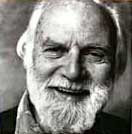
Douglas Harding, a retired English architect, was born in 1909 in Lowestoft. His family had belonged for generations to the Christian fundamentalist sect known as the Exclusive Plymouth Brethren. Harding gives an account of his early life in the sect in a Postscript to his book The Trial of the Man Who Said He was God, a picture of puritanical rejection of the modern world, and rejection of any other religious outlook. At the age of 21 he composed a ten-page thesis outlining his opposition to the tenets of the sect, and found himself appearing before 'a kangaroo court of fanatics'. Needless to say he was found guilty of heresy and expelled from sect, family and lodgings. Harding spent the rest of his life pursuing and developing the ideas he had set out in his apostatic thesis.
Harding was posted to India in the second world war and tells us that his experiences there intensified his spiritual searching. He recalls that he was absolutely plagued in his early life with self-consciousness — a really 'virulent British sort' (as he calls it) — which was quite destroyed by his discovery of 'headlessness'. Although he spent some time much later in the ashram of the Indian guru Anandamayi Ma, it was not through the spiritual traditions of India that Harding came to his key insight. He was a thirty-three year old soldier on leave in the Himalayas when he made this discovery:
What actually happened was something absurdly simple and unspectacular: I stopped thinking. A peculiar quiet, an odd kind of alert limpness or numbness, came over me. Reason and imagination and all mental chatter died down. For once, words really failed me. Past and future dropped away. I forgot who and what I was, my name, manhood, animalhood, all that could be called mine. It was as if I had been born that instant, brand new, mindless, innocent of all memories. There existed only the Now, that present moment and what was clearly given in it. To look was enough, and what I found was khaki trouserlegs terminating downwards in a pair of brown shoes, khaki sleeves terminating sideways in a pair of pink hands, and a khaki shirtfront terminating upwards in - absolutely nothing whatever! Certainly not a head. It took me no time at all to notice that this nothing, this hole where a head should have been, was no ordinary vacancy, no mere nothing. On the contrary it was very much occupied. It was a vast emptiness vastly filled, a nothing that found room for everything - room for grass, trees, shadowy distant hills, and far above them snow-peaks like a row of angular clouds riding the blue sky. I had lost a head and gained a world. It was all, quite literally, breathtaking. I seemed to stop breathing altogether, absorbed in the Given. Here it was, this superb scene, brightly shining in the clear air, alone and unsupported, mysteriously suspended in the void, and (and this was the real miracle, the wonder and delight) utterly free of "me", unstained by any observer. Its total presence was my total absence, body and soul. Lighter than air, clearer than glass, altogether released from myself, I was nowhere around. Yet in spite of the magical and uncanny quality of this vision, it was no dream, no esoteric revelation. Quite the reverse: it felt like a sudden waking from the sleep of ordinary life, an end to dreaming. It was self-luminous reality for once swept clean of all obscuring mind. It was the revelation, at long last, of the perfectly obvious. It was a lucid moment in a confused life-history. It was a ceasing to ignore something which (since early childhood at any rate) I had always been too busy or too clever to see. It was naked, uncritical attention to what had all along been staring me in the face - my utter facelessness. In short, it was all perfectly simple and plain and straightforward, beyond argument, thought, and words. There arose no questions, no reference beyond the experience itself, but only peace and a quiet joy, and the sensation of having dropped an intolerable burden.
This passage is found in two of Harding's books, and has been reproduced in Douglas Hofstadter and Daniel Dennett's influential compilation The Mind's I. Harding's first book, The Hierarchy of Heaven and Earth, was sent in manuscript form to C.S.Lewis, who reviewed it favourably, and with which review it is now published. Harding's best-known work came later and is called On Having No Head, with a later subtitle Zen and the Rediscovery of the Obvious.
Harding has published a series of books since these early attempts to put his vision into writing, but it is probably through his workshops that most people 'get it'. If his insights rely on no tradition, yet can be understood in the light of many traditions, his techniques are truly unique. Harding has invented a series of exercises, some done singly, some in pairs, and some with larger groups, all with the single purpose of showing 'who one truly is'. He has led these workshops all around the world for at least fifty years, and at the age of over 90 continues an extraordinary itinerary as this programme for the year 2000 shows:
Harding pursued a career in architecture after the war, building his own home in Suffolk. He married but was eventually separated, perhaps because his vision had such a powerful hold on his life and not everyone can share in it. In the mid 1990's he met Katherine, whose background was mainly Buddhist, and they married not long after. They now present the workshops jointly.
Harding's temperament and means of expression have an affinity with the 'sudden' enlightenment of Zen, and in the early days of his teaching he was promoted by Buddhist groups (the first edition of On Having No Head was published by the Buddhist Society in Eccleston Square). He was too radical for most of them however, provoking this comment (found in the introduction to Urgyen Sangarakshita's The Taste of Freedom): "The talks and study groups [at a Buddhist summer school] run from Therevada to Zen, through Zoroastrianism and Vedanta, to a sort of bizarre synthesis of ancient and modern teachings, whose pundit encourages his disciples to spend substantial periods of time with paper bags over their heads." This is an obvious reference to Harding's paper bag experiment, outlined below, and perhaps typical of how he is misunderstood. In fact all kinds of religious organisations invite Harding to give his unique workshops all over the world, including Ramana Maharshi groups. Harding's affinity with Maharshi lies in the emphasis on establishing or even merely 'noticing' one's true identity. He says of his experience in India quoted above that it had not been the result of any formal meditation or practice, but with a preoccupation with the question of his own identity. Harding cites both the Buddha and Maharshi in the following passage:
The Buddha's description of Nirvana, in the Pali Canon, as "visible in this life, inviting, attractive, accessible," is clearly true and makes perfect sense. So does Master Ummon's statement that the first step along the Zen Path is to see into our Void Nature: getting rid of our bad karma comes after - not before - that seeing. So does Ramana Maharshi's insistence that it is easier to see What and Who we really are than to see "a gooseberry in the palm of our hand" - as so often, this Hindu sage confirms Zen teaching. All of which means there are no preconditions for this essential in-seeing. To oneself one's Nature is forever clearly displayed, and it's amazing how one could ever pretend otherwise. It's available now, just as one is, and doesn't require the seer to be holy, or learned, or clever, or special in any way. Rather the reverse! What a superb advantage and opportunity this is!
Douglas helps one see one's own nature in a direct and repeatable way. His technique involves a series of 'experiments' with all the exhortations to scientific rigour that the word implies, though they are based on the consensus of the first person, unlike conventional science which is based on the consensus of the third person. In the conventional physical sciences the first person is the experimenter and the second person (or subject matter) is the object of one's experiment: it might involve lenses and light, electronic circuits and electromagnetism, or biological tissue and chemical substances. The third person, or third persons, is the rest of the scientific community who have an interest in the hypothesis that the experimenter is evaluating, and the possibility to repeat the experiments in order to verify or disprove the hypothesis. Out of this arrives the consensus of the third person and all scientific orthodoxies. In the social sciences, and in particular psychology, the second person in these experiments is just that: a person, or a group of persons, and the route to scientific orthodoxies in these fields follow a similar path to the physical sciences though it is debatable how well the parallel holds. It is still, in its conceptual model at least, a consensus of the third person. Douglas's experiments follow a consensus of the first person in this sense: questions are established (all of which relate to "who am I?") and a group of people carry out a process involving observations on their own perceiving, resulting in answers to the questions. The second person or object of the experiment is the experimenter him or herself; a guide may be present in the form of Douglas, but the third person has no entry to the experiment (and an unprepared third party may even find the proceedings rather comical). The moment that the third person, acquainted with Douglas's hypotheses, wishes to verify them they become the first person in carrying out the experiment. Another way of saying this is that this form of spiritual enquiry is a science whose subject matter is you in the first person. Most of Douglas's experiments revolve around the sense of sight, and are designed to bring home to one an essential asymmetry between the observer and other human beings, an asymmetry that paradoxically brings one to a form of love — a simple openness to the existence of others.
An example of an experiment to show this involves four people, or more accurately, three people and the observer (first person). The observer stands facing one of the others, while the other two stand in such a way that their line of sight is at right angles to the observer's and across the observer's, i.e. in a little cross-shape. As one stands, looking at the face opposite, one is asked to notice that the 'first-person' type of looking between the observer and the person opposite is quite different to the 'third-person' type of looking that the other two are engaged in at right angles to one's line of sight. In one's own looking there is no face or head at the observer's end; the only face one possesses is the one opposite. Instead of a face of one's own one has space, space for all the world. For the other two, they are truly 'face to face' — closed at both ends of the gap between them by matter — matter that has shape, colour, and detail; prone to age, decay and death, quite unlike one's own which has no boundaries, which is colourless and featureless, and — thank God! is deathless. One could not read this page if one were not built open for it — built open for loving. In Douglas's workshops he arranges the participants into the necessary groupings to carry out the experiments (four in the above example) and then talks the group through them: he invites one to see what one really sees.
Probably the best known of Douglas's experiments involves the use of a paper bag open at each end, with a couple of unobtrusive holes in the middle for air. Two participants are invited to fit the bag over their faces so that they look at each other's face unencumbered by any surrounding other than the luminous white of the bag, mostly out of focus at that. It is a claustrophobic experience, and a threatening one : only in encounter groups is one asked to look this closely into another person's face, but of course, with Douglas there is no intention to engage emotionally with the situation. He invites one to notice again the difference between what is at one end of the bag and what is at the other end — a radical difference and, in normal life, almost always overlooked. (Harding has commented that at one end there is nothing material, and at the other end there is nothing spiritual.) The simplicity and ludicrousness of the bag situation are an affront to the intellect, and, with luck it retires hurt so that one can get on with noticing the pristine spotlessness and eternal nature of one's own end of the bag.
Harding does not recommend long periods in the paper bag, whatever others say, but what does he recommend as a general practice? He offers this:
Now the "hard" part begins, which is the repetition of this headless seeing-into Nothingness till the seeing becomes quite natural and nothing special at all; till, whatever one is doing, it's clear that nobody's here doing it. In other words, till one's whole life is structured round the double-barbed arrow of attention, simultaneously pointing in at the Void and out at what fills it. Such is the essential meditation of this Way. It is meditation for the market-pace, in fact for every circumstance and mood, but it may usefully be supplemented by regular periods of more formal meditation — for example, a daily sitting in a quiet place enjoying exactly the same seeing, either alone or (better) with friends. Here, in fact, is a meditation which doesn't threaten to divide our day into two incompatible parts — a time of withdrawal and quiet recollection, and a time of self-forgetful immersion in the world's turmoil. On the contrary, the whole day comes to have the same feel, a steady quality throughout. Whatever we have to do or take or suffer can thus be turned to our immediate advantage: it provides just the right opportunity to notice Who is involved. (To be precise, absolutely involved yet absolutely uninvolved.) In short, of all forms of meditation this is among the least contrived and obtrusive, and (given time to mature) the most natural and practical. And amusing too: it's as if one's featureless Original Face wore a smile like that of the disappearing Cheshire Cat!
Much later in life Harding seems to have a momentary doubt about the validity of 'headlessness'. In 'On Having A Head' published in a recent collection of essays, Harding reconsiders an obvious objection, one that must have been made many times to him over his years of teaching. He says:
And then, for no reason I know of, it suddenly occurred to me that a man born blind, fingering one of his hands and then his head, has as much reason for believing in the latter as in the former. Please check this for yourself right now. Go blind (that's to say, close your eyes), handle your left hand with your right, then your left arm and shoulder, your neck, and finally your head - back, sides, and front, all over. Isn't the present evidence for your head just as convincing as for your hand? for a head, moreover, which is as firmly attached to your trunk as your hand is to your arm. Now let's admit it, a fundamental truth that's untrue for a blind man isn't a fundamental truth at all. It doesn't deserve to be taken seriously. And certainly it's no foundation for building a life on. So I found myself asking myself some awkward questions. What if, all through those years of dedicated endeavour, I had been mistaken? Or worse, had more or less unconsciously suppressed vital evidence, cooking the books in favour of a cherished theory, not to say obsession? Could it be that - more hidden from me than from others - my stratagem for reversing my feelings of inferiority and getting noticed at any price, for hoisting myself head and shoulders above the masses, had been to pretend I lacked head and shoulders? How's that for irony?
The way in which he takes this objection and rescues 'headlessness' out of it is classic Harding, but also shows that, even in his eighties or nineties he continues to think deeply about his insights. It also contains a theme that emerged in his seventies, a Christ-centred aspect to his teachings. In the Postscript to The Trial of the Man Who said he was God, Harding tells us that he rediscovers aspects of the religion taught to him as a child, and rejected as a young man.
Ramana Maharshi demonstrates a classical jnani case, and Sri Ramakrishna a classical bhakti case amongst the great Masters of transcendence. They both represented, in slightly different ways, the via negativa, and they both used the ancient spiritual language of their culture. Douglas Harding is a jnani of a very different type, using a language, instruction and metaphor that is entirely new, and entirely his own, though he is conversant with the world's spiritual traditions. He also demonstrates an exquisite balance between via negativa and via positiva. His teaching revolves around the question of one's identity, and therefore resonates with Ramana's 'who am I?' and it is often followers of Ramana who invite him to give his workshops.
Harding's interesting confession some fifty years after he started his teaching of headlessness, that it does not work for a blind person, prompted him to refine his earlier statements. But he cannot do it from any perspective involving closed eyes or non-functioning vision, he has to do it from the percepts of vision. All this means is that Harding's teachings are much more likely to work for a sighted person who happens to have a very strong visual sense. For headlessness to work one needs a strong perceptual sense of vision, a very active way of looking at the world, before its inversion can demonstrate that one really is space for the world. If one barely looks at anything in the first place, headlessness will not be an easy proposition or path to the divine. In this sense Harding may be right when he says that it works just as well for sighted as for unsighted people. As Harding quickly spotted, a child who is still in a state of wonder with the world has a very good chance of 'getting it', as did Thomas Traherne in his advocacy of the 'infant eye'. We can say then that Harding's teachings work for those of a jnani orientation, with a developed visual sense, and the child-like mind adept at spotting the 'Emperors new clothes' for what they are.
Above all Harding's work can show us like no other the nature of our being, in particular its nature in respect to the world. Ramana and Ramakrishna cannot illuminate our relationship with the manifest universe because they are renunciative, intensely via negativa, shown even in their personal lives. Harding's life is not renunciative in the slightest, and so the importance of his message is amplified for all those not in a position, whether from temperament or circumstance, to enter the renunciative life. If Harding's 'headlessness' corresponds to the Void, to nirvana (in the Pali sense), to the imperishable or unmanifest in Indian thought, then it cannot be apprehended without the manifest, bright, luminous World that fill it.
Harding does not wish us to wallow in our superb nothingness to the exclusion of the world. In Head Off Stress he advocates an identification with both the nothing and the everything as the cure for the modern affliction of stress:
Two escape routes lie open to you. The first is to become so small, so empty, so exclusive that there's nothing to you, nothing to be got at, nothing to act upon or react. The second is the opposite of this. It is to become so big, so full, so inclusive that there remains nothing outside you to get at you, nothing to pressurize you or to influence you at all, nothing left for you to react to. Let's put it differently. Particular things are stressed. If you were no thing you would be stress-free. Conversely, if you were all things you would, again, be stress-free. And if, by great good luck, you were both — if you were at once no thing and all things — why then you would be doubly stress-free, free beyond all doubt. This way, you would avoid being one of those unlucky intermediate things — things which are neither empty enough nor full enough to be free from stress. You would avoid falling between the two stools of total emptiness and total fullness, by sitting firmly on both stools at the same time. As nothing and everything you would be sitting pretty. You would be safe as well as comfortable. You would have arrived at our goal. You would already be established in the promised Land of No Stress, no matter how long it took you to feel at home and to get acclimatized. Well, I say you are sitting pretty, you are as lucky as that!
This passage clearly shows Harding's extraordinary balance between via negativa and via positiva, indicating even that one can pursue both at the same time.
This is a good point to examine the charge laid against Harding that his teachings are solipsistic, and to look at this issue in connection with the spiritual life. The Chambers 20th Century Dictionary gives this definition of solipsism: "the theory that self-existence is the only certainty, absolute egoism — the extreme form of subjective idealism; from the Latin roots solus, alone and ipse, self". Clearly, for many people the term would carry a negative connotation because of the 'absolute egoism' that it implies. The idea that one is the centre of the universe, the beginning and ending of all things, and that all other phenomenon, including other people, are part of a flux the only unchanging and permanent part of which is oneself, is at the heart of the mystics' sayings, and at the same time (at face value) both absurd and egoistic. Another common form of this is identity with God, as discussed earlier; also a statement that can arouses violent condemnation. Nambiar (one of Walt Whitman's Hindu commentators) quotes an appropriate passage from Rumi in which Rumi defends Mansur's 'I am God' against the very same charge of egoism:
This is what is signified by the words Ana'L Haqq, "I am God". People imagine that this is a presumptuous claim, whereas it is really a presumptuous claim to say "Ana'L Abd", " I am the slave of God"; and Ana'l Haqq, "I am God", is the expression of great humility. The man who says Ana'L Abd, "I am the slave of God" affirms two existences, his own and God's, but he who says Ana'L Haqq, "I am God", says "I am naught, He is all; there is nothing but God".
Rumi finds this "the extreme of humility and self-abasement". Solipsism is also a frightening idea because of the 'alone' part of its Latin root, present in the modern meaning of the word as an implied refusal to recognise others. In Harding's work this appears as an asymmetry: at the near end of the bag there is something (a nothing actually) quite different from what is seen at the far end of the bag — a reassuringly familiar face, even if it is of a stranger. Douglas finds that he is 'gone'; the universe is just 'built' this way, but also finds love in it. It is love of course that removes the sting of this uniqueness and loss of similarity with one's fellows: as one begins to identify with the 'space' for all things and see one's fellows as content of the space love restores to them their familiarity, or better makes them for the first time truly loveable. Edgar Cacey said that we meet only ourselves: how can one fail to love these manifestations of our true self? This world-view can lead to the fear of a callousness or indifference to the suffering of others, or to mild forms of megalomania, or in extreme cases to madness. It is vital not to underestimate that the jump from the 'normal' identification to the mystic identification with the cosmos implies a radical transformation of the individual — if this is occurs too fast or in an uneven way all kinds of problems can arise. Hence the emphasis in so many traditions on love and surrender, or, as exemplified in Buddhism, compassion. The Mahayana Buddhist teaching, that no individual should 'accept' enlightenment before ensuring that all others are enlightened first is firmly grounded in good pedagogy, but from Harding's perspective one's own enlightenment is the liberation of others. Love, surrender, compassion are emphasised by all mystical teachers, though it becomes hard to distinguish between these as pedagogical issues and as a natural outcome of the unitive state. Harding also counters the notion that identification with the Whole is special, euphoric or any kind of 'high', by calling it a valley experience — it is neither a peak nor a valley experience of course (something neutral in fact), but it is good to call it a valley experience to counter the sensation-seekers. .
Harding is explicitly against the guru-disciple relationship (as was Krishnamurti), and as an example of this dissects with great humour an imaginary relationship with an acolyte in The Trial of the Man Who Said He was God. His point, of course, is that the infinite and eternal (to use another terminology) that another lives in is of absolutely no use to the aspirant : it is their own apprehension of it that is vital, and guru-worship can so easily be used to postpone the moment of realising it oneself (and for Harding this has to be done now; no preparation is needed or is possible). We have pointed out however that in the appropriate context, such as that which Ramakrishna taught in, the guru, Sage or Master, can be of great benefit. It is probably that Harding's rejection of this possibility is rooted in unpleasant experiences, as we assume Krishnamurti's to be.
On a minor note we observe that Harding was thirty-three at the time of his major insight or revelation. It has been pointed out by many observers that the early-to-mid-thirties is the most common age in a person's life for a radical spiritual transformation.