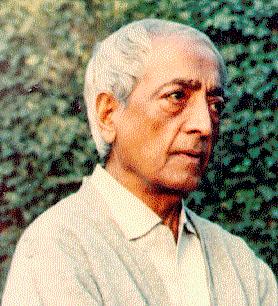
Krishnamurti's life is well-documented in Mary Lutyens' biography (see Bibliography). The Krishnamurti Foundation of America presents this brief history on its website:
The Person J. Krishnamurti (b. May 12, 1895, Madanapalle, Andhra Pradesh, India, d. February 17, 1986, Ojai, California) born of middle-class Brahmin parents, was recognized at age fourteen by the Theosophists Annie Besant and C.W. Leadbeater as the coming World Teacher and proclaimed to be the vehicle for the reincarnation of Christ in the West and of Buddha in the East. Mrs. Besant adopted the boy and took him to England, where he was educated and prepared for his coming role. He was made head of her newly formed worldwide religious organization, the Order of the Star in the East in 1911, but in 1929, after many years of questioning himself, he dissolved the Order, repudiated its claims and returned all the assets given to him for its purpose. Out of his own spiritual "process" experienced from 1922 onwards, he declared, "Truth is a pathless land and you cannot approach it by any path whatsoever, by any religion, by any sect. Truth, being limitless, unconditioned, unapproachable by any path whatsoever, cannot be organized; nor should any organization be formed to lead or to coerce people along any particular path. My only concern is to set humanity absolutely, unconditionally free."
Krishnamurti's mother may have had similar presentiment to those of Ramakrishna's mother about her future child, because she chose, against the explicit religious and caste instructions regarding birth, to deliver Krishnamurti in the puja room (shrine room) of her small house. As a child Krishnamurti was not considered unusual in any way, but was discovered in 1909 by Charles Leadbeater, a leading member of the Theosophical Society. His secretary had pointed him out, but was astonished at Leadbeater's prediction that Krishnamurti would one day be a great spiritual teacher, as he found the boy particularly stupid. Krishnamurti was in fact not academically gifted, and even after his private education and strict training failed to get into Cambridge University. This would come as a surprise to anyone who saw the incisive thinking in his written works, or demonstrated for example in the conversations between Krishnamurti and the eminent physicist David Bohm. The Theosophical Society had as its stated goal the preparation for a new World Leader, and before long it declared that it had found it in the person of Jiddu Krishnamurti. (This was to the disgust of the great esotericist Rudolf Steiner, who then left the Theosophical movement and founded the Anthroposophical movement.) Krishnamurti was prepared for his role through occult initiations at the hands of Leadbeater and Annie Besant, a process that involved communications with so-called disembodied 'Masters', and ultimately the excruciatingly painful preparation of his body to become the vessel for the (Buddha) Maitreya. Krishnamurti in later life had no recollection of most of these experiences, and vigorously denied that they contributed to his illumination. He gradually shook off the ministrations of the Theosophical Society, and in a dramatic gesture dissolved the Order of the Star, which was the organisation founded to support his work. He could no more shake of his destiny than any of us however, and entered a life of teaching that lasted fifty years. The teachings were his, however, and could be summed up in one phrase: choiceless awareness.
Krishnamurti could not be in greater contrast to Ramakrishna: he was educated (though mainly privately), sophisticated, an intellectual, and earnestly against the whole concept of devotion, either to a living person or to a deity. He simply jettisoned the whole of Indian religious history (as well as all other religious apparatus) and talked for fifty years on the pristine state of a silent mind that lives with choiceless awareness. His emphasis on no-mind borrows nothing from the Zen Buddhists, and he seems to have taken no interest in any spiritual figure or teaching, however similar to his own. He was reputed to read detective novels or watch Clint Eastwood movies by way of relaxation. But his being was illuminated and silent; others made Christ-comparisons throughout his life - here are some comments from contemporary figures:
George Bernard Shaw called Krishnamurti "a religious figure of the greatest distinction," and added, "He is the most beautiful human being I have ever seen."
Henry Miller wrote, "There is no man I would consider it a greater privilege to meet …"
Aldous Huxley, after attending one of Krishnamurti's lectures, confided in a letter, "… the most impressive thing I have listened to. It was like listening to the discourse of the Buddha — such power, such intrinsic authority … "
Kahlil Gibran wrote, "When he entered my room I said to myself, 'Surely the Lord of Love has come.'"
In August 1922 Krishnamurti underwent three days of a very intense and painful experience at Ojai Valley in California, during which one of his companions suggested that he sit under a young pepper tree in the garden, which proved to soothe him and under which he remained for a long time. As with many of the experiences he had in the period leading up to this time, Krishnamurti had no later recollection of the most intense parts, but he wrote afterwards of the period:
On the first day while I was in that state and more conscious of the things around me, I had the first most extraordinary experience. There was a man mending the road; that man was myself; the pickaxe he held was myself; the very stone which he was breaking up was a part of me; the tender blade of grass was my very being, and the tree beside the man was myself. I also could feel and think like the roadmender and I could feel the wind passing through the tree, and the little ant on the blade of grass I could feel. The birds, the dust, and the very noise were a part of me. Just then there was a car passing by at some distance; I was the driver, the engine, and the tyres; as the car went further away from me, I was going away from myself. I was in everything, or rather everything was in me, inanimate and animate, the mountain, the worm and all breathing things. All day long I remained in this happy condition.
(later in the same account:)
I was supremely happy, for I had seen. Nothing could ever be the same. I have drunk of the clear and pure waters at the source of the fountain of life and my thirst was appeased. Nevermore could I be thirsty. Never more could I be in darkness; I have seen the Light, I have touched compassion which heals all sorrow and suffering; it is not for myself, but for the world. I have stood on the mountain top and gazed at the mighty Beings. I have seen the glorious and healing Light. The fountain of Truth has been revealed to me and the darkness has been dispersed, Love in all its glory has intoxicated my heart; my heart can never be closed. I have drunk of the fountain of Joy and eternal Beauty. I am God-intoxicated.
This is one of the rare passages where Krishnamurti talked about himself, and is typical of how mystics describe their illumination, but it is in contrast to his later writings. The eternal and infinite are everywhere in his teachings and writings, perhaps with the greater emphasis on the ending of the passage of time, through the silence of the mind. Krishnamurti's embraciveness shows in his commitment to teaching, but also in a more relaxed attitude to the manifest world than shown by the previous two examples. Although he showed moderation in material things, he did like to dress smartly, and enjoyed sports-cars, his dogs, gardening, reading and films; his Indian instinct for renunciation only showing itself in a vague dismissal of human affairs such as war and politics, and a general distaste for the coarser sides of life. His embraciveness, though not of the type that is shown in full via positiva, showed another important aspect that we shall look at in the section on Nature Mysticism: a love of nature.
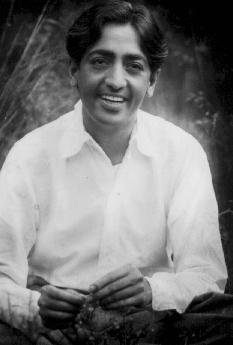
It is a view held by some that Krishnamurti was enlightened, but a poor teacher, yet over the years of his teaching many thousands from all over the world attended his talks, attracted by his reputation and his words, and upon whom he had an enormous impact. One of these was Andrew Cohen, who claims that seeing Krishnamurti was one of the turning points in his spiritual development. The following passage, from The Only Revolution, gives the flavour of Krishnamurti's teachings:
Meditation is not the repetition of the word, nor the experiencing of a vision, nor the cultivating of silence. The bead and the word do quiet the chattering mind, but this is a form of self-hypnosis. You might as well take a pill.
Meditation is not wrapping yourself in a pattern of thought, in the enchantment of pleasure. Meditation has no beginning, and therefore it has no end.
If you say: "I will begin today to control my thoughts, to sit quietly in the meditative posture, to breathe regularly" — then you are caught in the tricks with which one deceives oneself. Meditation is not a matter of being absorbed in some grandiose idea or image: that only quietens one for the moment, as a child absorbed by a toy is for the time being quiet. But as soon as the toy ceases to be of interest, the restlessness and the mischief begin again. Meditation is not the pursuit of an invisible path leading to some imagined bliss. The meditative mind is seeing — watching, listening, without the word, without comment, without opinion — attentive to the movement of life in all its relationships throughout the day. And at night, when the whole organism is at rest, the meditative mind has no dreams for it has been awake all day. It is only the indolent who have dreams; only the half-asleep who need the intimation of their own states. But as the mind watches, listens to the movement of life, the outer and the inner, to such a mind comes a silence that is not put together by thought.
It is not a silence which the observer can experience. If he does experience it and recognise it, it is no longer silence. The silence of the meditative mind is not within borders of recognition, for this silence has no frontier. There is only silence — in which the space of division ceases.
(pages 19 - 20)
Like Ramana he does not recommend outward forms of self-discipline, but unlike him (and the others in this chapter) he is outspoken in his condemnation of all gurus, teachers, Masters and so on. His antipathy to the whole context of master and disciple may have been a result of his early training, but it placed him in a paradoxical position as a teacher, for he knew in his heart the same thing that Ramakrishna and Ramana Maharshi knew: association with him could change people. More than any of these masters he attempted to give the aspirant independence and self-reliance from the outset, but his own nature and background and the nature of seekers in general made this maddeningly difficult. In the following transcript of a conversation between Krishnamurti and the physicist (and friend) David Bohm Krishnamurti is the master and Bohm is the disciple, but the dialogue has the outward form of equality, or even an inversion of roles.
Bohm: You see, one of the things that often causes confusion is that, when you put it in terms of thought, its seems that you are presented with the fragments that are real, substantial reality. Then you have to see them, and nevertheless you say, as long as the fragments are there, there is no wholeness so that you can't see them. But that all comes back to the one thing, the one source.
KRISHNAMURTI: I am sure, Sir, really serious people have asked this question. They have asked it and tried to find an answer through thought.
Bohm: Yes, well it seems natural.
KRISHNAMURTI: And they never saw that they were caught in thought.
Bohm: That is always the trouble. Everybody gets into this trouble: that he seems to be looking at everything, at his problems, saying, "Those are my problems, I am looking." But that looking is only thinking, but it is confused with looking. This is one of the confusions that arises. If you say, don't think but look, that person feels he is already looking.
KRISHNAMURTI: Quite. So you see, this question has arisen and they say, "All right, then I must control thought, I must subjugate thought and I must make my mind quiet so that it becomes whole, then I can see the parts, all the fragments, then I'll touch the source." But it is still the operation of thought all the time.
Bohm: Yes, that means the operation of thought is unconscious for the most part and therefore one doesn't know it is going on. We may say consciously we have realised that all this has to be changed, it has to be different.
Bohm is certainly Krishnamurti's intellectual equal, and Krishnamurti directs the conversation in the detached scientific manner of the debating hall, but now picks up on Bohm's mention of the unconscious and moves the interaction into a different gestalt.
KRISHNAMURTI: But it is still going on unconsciously. So can you talk to my unconscious, knowing my conscious brain is going to resist you?
Krishnamurti puts Bohm in the position of the master, and himself in the position of the aspirant; at the same time he poses the question that all masters ask of themselves — how to reach the depth of their disciple. The disciple has come to the master, but they are going to resist him nevertheless: this is the ancient dilemma. The dialogue unfolds in a revealing way, Krishnamurti still speaking:
Because you are telling me something which is revolutionary, you are telling me something which shatters my whole house which I have built so carefully, and I won't listen to you — you follow? In my instinctive reactions I push you away. So you realise that and say, "Look, all right, talk to your unconscious. I am going to talk to your unconscious and make that unconscious see that whatever movement it does is still within the field of time and so on." So your conscious mind is never in operation. When it operates it must inevitably either resist, or say, "I will accept"; therefore it creates a conflict in itself. So can you talk to my unconscious?
Bohm: You can always ask how.
KRISHNAMURTI: No, no. You can say to a friend, "Don't resist, don't think about it, but I am going to talk to you." "We two are communicating with each other without the conscious mind listening."
Bohm: Yes.
KRISHNAMURTI: I think this is what really takes place. When you were talking to me — I was noticing it — I was not listening to your words so much. I was listening to you. I was open to you, not your words, as you explained and so on. I said to myself, all right, leave all that, I am listening to you, not to the words which you use, but to the meaning, the inward quality of your feeling that you want to communicate to me.
Krishnamurti is not telling Bohm that he is ignoring him, the eminent physicist, but hinting at how Bohm should listen to Krishnamurti — not to the words but to the deeper meaning. They go on in this inverted fashion:
Bohm: I understand.
KRISHNAMURTI: That changes me, not all this verbalisation. So can you talk to me about my idiocies, my illusions, my peculiar tendencies, without the conscious mind interfering and saying, "Please don't touch all this, leave me alone!" They have tried subliminal propaganda in advertising, so that whilst you don't really pay attention, your unconscious does, so you buy that particular soap! We are not doing that, it would be deadly. What I am saying is: don't listen to me with your conscious ears but listen to me with the ears that hear much deeper. That is how I listened to you this morning, because I am terribly interested in the source, as your are. You follow, Sir? I am really interested in that one thing. All this is the explicable, easily understood — but to come to that thing together, feel it together! You follow? I think that is the way to break a conditioning, a habit, an image which has been cultivated. You talk about it at a level where the conscious mind is not totally interested. It sounds silly but you understand what I mean?
Say for instance I have a conditioning; you can point it out a dozen times, argue, show the fallacy of it, the stupidity — but I still go on. I resist, I say what it should be, what shall I do in this world otherwise, and all the rest of it. But you see the truth, that as long as the mind is conditioned there must be conflict. So you penetrate or push aside my resistance and get to that, get the unconscious to listen to you, because the unconscious is much more subtle, much quicker. It may be frightened, but it sees the danger of fear much quicker than the conscious mind does. As when I was walking in California high in the mountains: I was looking at birds and trees and watching, and I hear a rattle and I jumped. It was the unconscious that made the body jump; I saw the rattler when I jumped, it was two or three feet away, it could have struck me very easily. If the conscious brain had been operating it would have taken several seconds.
Bohm: To reach the unconscious you have to have an action which doesn't directly appeal to the conscious.
KRISHNAMURTI: Yes. That is affection, that is love. When you talk to my waking consciousness, it is hard, clever, subtle, brittle. And you penetrate that, penetrate it with your look, with your affection, with all the feeling you have. That operates, not anything else.
This is a rare admission by Krishnamurti (and his attempt to disguise it does not fool us) that he is the guru, teacher, master, or guide, and that the master operates through love regardless of whether he teaches awareness, self-enquiry, or devotion.
Krishnamurti is one of the greatest Indian Masters to teach in the West. While Vivekananda in 1891 was the first to establish Indian teachings on American soil (Paramahansa Yogananda following some thirty years later in his footsteps) Krishnamurti disassociated himself with the spiritual heritage of his birth. He was a gentle iconoclast, in that he simply ignored Indian spiritual traditions rather then attempting to destroy them. He was however fiercely outspoken against the guru principle, and this message found a sympathetic hearing in the West. Ironically, as we have seen, his life's work and very mode of interaction with aspirants is that of the guru. We see a classical problem in the development of any sphere of human activity: once a process that requires trust and vulnerability is abused in a particular case the very process is denied in the general. Intellectually Krishnamurti may have found a way to circumvent the master/disciple relationship, but the ancient Indian self-confidence, as found in the life of the Buddha onwards, asserts itself time and again.
What Krishnamurti taught however is classical non-dualism. It is a simple and beautiful jnani teaching, made all the purer considering the occult overtones of his early training, which he jettisoned in their entirety. In contrast to his approximate contemporary and temperamantal opposite, G.I.Gurdjieff, Krishnamurti emphasised that the deep moments come unasked for, without any method of preparation or programme of spiritual 'work'. For Krishnamurti, though he may have not used the word, it was a matter of grace. Krishnamurti was not a renunciate like Maharshi or Ramakrishna, but neither did he participate in ordinary life in the way that Douglas Harding did (involving military life, married life, and career as architect). Krishnamurti's life was always cocooned by the organisations surrounding him, so after his rather innocent childhood he had little contact with ordinary life. Hence we find in him a certain remoteness, perhaps contributed to by the tragic loss of his younger brother, a shock that affected him profoundly. What separates Krishnamurti from Ramana and Ramakrishna however is an unusual love for Nature. Krishnamurti was no optimist about the world, but his love of landscape, plants, and animals was highly developed, and found expression in some of the most beautiful descriptive prose to be found anywhere. Although Krishnamurti could not be described as a full Nature mystic, his Nature writings make a great contribution to its understanding (see section on Nature Mysticism).
|
'Krishnamurti
taught a classical non-dualism, a simple and beautiful jnani teaching.
The same aesthetic sensibility that gave Krishnamurti the eye and temperament
to see the exquisite beauty in Nature, made him wince at the sometimes
coarse and brutal nature of Man, a problem at the heart of via positiva.'
|
If it is clear the Krishnamurti is a great jnani, how are we to understand the balance of via positiva and via negativa in his life and teachings? He was not optimistic about the human condition, never married, and did not easily engage with the man in the street or in good-natured rustabout, yet in according to his own taste enjoyed many of the good things in life. In his teachings he did not advocate renunciation, so it would not be right to say that via negativa was directly part of his vision, but neither did he construct an elegant understanding of the nature of the manifest world, as Harding did, to balance the inner silence and space that he advocated. Where Krishnamurti does take a large stride on the via positiva is entirely in connection with Nature, and this aspect of his teaching is an essential but neglected part of his unique contribution. We also gain an insight into the basis of Nature Mysticism, that it partly derives from an aesthetic sensibility. One could say that it was the same aesthetic sensibility that gave Krishnamurti the eye and temperament to see the exquisite beauty in Nature (and we are lucky indeed that he combined this with no mean gift as a writer), as made him wince at the sometimes coarse and brutal nature of Man. This conundrum is at the heart of the problem of via positiva.