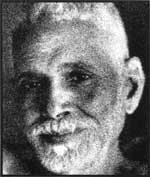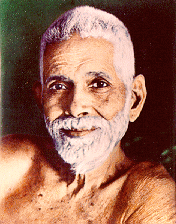
Ramana Maharshi was born in 1889 to a middle-class Brahmin family in South India, showing no special aptitude for religion, but, at the age of seventeen underwent a spontaneous transformation. Ramana described the awakening in his own words.
It was about six weeks before I left Madura [Maharshi's home town] for good that the great change in my life took place. It was quite sudden. I was sitting alone in a room on the first floor of my uncle's house. I seldom had any sickness, and on that day there was nothing wrong with my health, but a sudden violent fear of death overtook me. There was nothing in my state of health to account for it, and I did not try to account for it or find out whether there was any reason for the fear. I just felt "I am going to die" and began thinking what to do about it. It did not occur to me to consult a doctor or my elders or friends; I felt that I had to solve the problem myself, there and then.
The shock of the fear of death drove my mind inwards and I said to myself mentally, without actually framing the words: "Now death has come; what does it mean? What is it that is dying? This body dies." And at once I dramatised the occurrence of death. I lay with my limbs stretched out stiff as though rigor mortis had set in and imitated a corpse so as to give greater reality to the enquiry. I held my breath and kept my lips tightly closed so that no sound could escape, so that neither the word "I" nor any other word could be uttered. "Well then," I said to myself, "this body is dead. It will be carried stiff to the burning ground and there burnt and reduced to ashes. But with the death of this body am I dead? Is the body I? It is silent and inert but I feel the full force of my personality and even the voice of the 'I' within me, apart from it. So I am Spirit transcending the body. The body dies but the Spirit that transcends it cannot be touched by death. That means I am deathless Spirit." All this was not dull thought; it flashed through me vividly as living truth which I perceived directly, almost without thought-process. "I" was something very real, the only real thing about my present state, and all the conscious activity connected with my body was centred on that "I". From that moment onwards the "I" or Self focused attention on itself by a powerful fascination. Fear of death had vanished once and for all. Absorption in the Self continued unbroken from that time on. Other thoughts might come and go like the various notes of music, but the "I" continued like the fundamental sruti note that underlies and blends with all the other notes. Whether the body was engaged in talking, reading, or anything else, I was still centred on "I". Previous to that crisis I had no clear perception of my Self and was not consciously attracted to it. I felt no perceptible or direct interest in it, much less any inclination to dwell permanently in it.
Ramana had entered into a state of pure consciousness. His description of it, generally uncluttered with technical terms, is useful for the understanding of jnani: he is describing an unbroken awareness of the centre of his being, capable of existing as the ground to all his sensations and not overwhelmed by them. Any aspirant on the path of awareness will know that attempts to maintain such awareness in the supposedly ideal circumstances of formal meditation practice, where distractions are at a minimum, is hard enough, but to do so while reading or talking is nothing short of miraculous. Ramana had a maturity at seventeen that was remarkable, for the onset of his experience would have been simply frightening even for most adults. Instead, he turned the experience into an enquiry into his nature, an approach that became the core of his pedagogy for the rest of his life. For some weeks after his transformation he attempted to continue the life of a schoolboy and son to his parents. It became obvious to them that he had changed, as he lost interest in boyish things and became indifferent to food. Legend has it that he stole the collection after worship at the local temple and used the money to make what was to be the last journey of his life — to Tiruvannamalai and the holy hill of Arunachala.
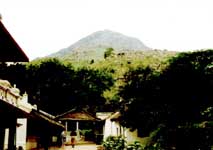
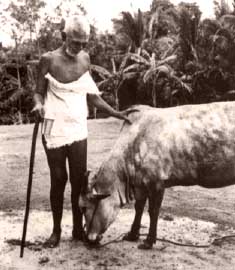
His flight from family and friends is a little reminiscent of the English mediaeval mystic Richard Rolle, who persuaded his sister to steal his father's cape and cloak in order to make a rough monk's habit out of it. Ramana abandoned himself to his revelation, to the point of neglecting his body and all external reality. He is supposed to have been infested with vermin by the time that locals began to look after him, in no doubt that he was a holy man. Ramana's change of orientation was so sudden and so complete that we see him becoming quite indifferent to the manifest world, to the point where he might have died of disease or starvation. This initial period, where he displayed no interest in disciples or teaching, gradually gave way to the more conventional life of a spiritual teacher and led to a fifty-year spell of teaching the path to self-realisation. A spiritual community grew around Ramana, and there remains some colour film footage of the ashram showing Ramana in his later years with his disciples, including a moving account of the death of the ashram cow. Ramana himself died of cancer in 1950.
Ramana was almost entirely unlearned in the Hindu scriptures at the time of his realisation (enlightenment), making him the mirror-image of the spiritual society so prevalent in India. Most people, including the general public and the Brahmins or priests, were at the time of Ramana's early life only too ready to quote the most profound elements of their spiritual heritage, such as 'Atman is Brahman', with very little direct experience of the truth behind the words. Ramana had discovered the truth but had very little scriptural knowledge. In time however this changed, not because he became more scholarly, but because his pupils wanted him to comment on and explain their favourite texts. Hence Ramana became associated with the Advaita or non-dualist school of illumination, as this was closest to his own experience, though he would provide an insightful commentary on any of the Indian spiritual treasures, including the more devotional. Ramana wrote little, usually in response to questions from his devotees, some of which is original verse and some of which is in the form of commentaries on key texts from the ancient traditions. Ramana's own writings add up to not more than about 80 pages, but are superb summary of the quintessential Hindu teachings of moksha (liberation), taken from personal experience but using an existing language and metaphor.
Amongst Ramana's pupils was a man called Poonjaji or Papaji, who in turn was the pivotal teacher in Andrew Cohen's spiritual development. Poonjaji (1908 - 1997) was an Indian military officer burdened by visions of Krishna until awakened in the presence of Ramana Maharshi in the 1940's.
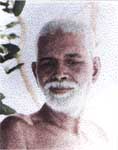
Ramana's essential teaching was the question "who am I?" As we saw in his own account it was this question that he used to penetrate the mystery of his own experience. It has to be an active principle as he explains: 'It is not right to make an incantation of "Who am I?" Put the question only once and then concentrate on finding the source of the ego and preventing the occurrences of thoughts.' Ramana did not underestimate the difficulty of this task, saying that no answer provided by the ego such as 'I am Siva' was adequate. He used the traditional language of non-dualism when describing the state that was to be attained, including the ancient formulation 'Atman is Brahman'. His views were fairly conventional in that he insisted that thoughts had to end, and that the way to do this was to disengage with the manifest world and to undermine the ego.
Ramana did not advocate renunciation for his devotees however, teaching that the challenges of everyday life were to be used as raw material for the quest for one's true identity. This was an original contribution to spiritual life in India, where it is usually expected that real spiritual progress comes only after an extended period of renunciation, asceticism, and even hardship. Ramana taught that his method could be used in every situation of daily life, asking 'who is experiencing success? who is experiencing failure?' and so on. As is inevitable for a spiritual teacher, many of those coming to him were not immediately interested in the question of identity, but in solving a problem in their lives. To such enquiries his response was always that the solution lay in seeing who it was that had the problem.
Although by temperament his teachings were not explicitly devotional, he exhorted his disciples to rest in the 'cave of the heart', an ancient expression that implies both love and silence. He also recognised that contact with genuine Masters could bring the disciple to self-realisation more effectively than any practice, thus acknowledging an aspect of the devotional referred to as satsang or darshan (being in the presence of the Master). Ramana prefers the more neutral term association:
1. Association with Sages who have realized the Truth removes material attachments; on these attachments being removed the attachments of the mind are also destroyed. Those whose attachments of mind are thus destroyed become one with That which is Motionless. They attain Liberation while yet alive. Cherish association with such Sages.
2. That Supreme State which is obtained here and now as a result of association with Sages, and realized through the deep meditation of Self-enquiry in contact with the Heart, cannot be gained with the aid of a Guru or through knowledge of the scriptures, or by spiritual merit, or by any other means.
3. If association with Sages is obtained, to what purpose are all the methods of self-discipline? Tell me, of what use is a fan when the cool, gentle, south wind is blowing?
Ramana was the cool wind and "who am I?" was his pedagogy. Note that in (2) above Ramana distinguishes between 'Sage' and 'Guru', meaning that a guru is lesser and incapable of spiritual instruction. His use of the word 'Guru' is not the same as used in this site, and it is not easy to enter the linguistic climate of his time and location or that of his translator to understand Ramana's precise point here, beyond the obvious one that there are true and false Masters (to use our terminology). We can do nothing more than press for the intellectual fluidity that can take words as temporary and contingent pointers to shared experience.
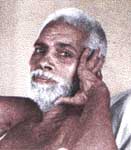
Ramana Maharshi is one of the clearest cases of a jnani Master in recent history, whose life and teachings are well-documented, and therefore not susceptible to the mythologising tendencies of history. Ramana is jnani and via negativa. Any aspirant with the same instincts will find in the short texts by Ramana a clear and concise description of the path and goal that lies ahead of them, though couched in the ancient spiritual language of India. For those whom this language presents an obstacle there are teachers like Cohen, Harding and Krishnamurti whose teachings are close in spirit but don't use the archaic and Eastern concepts of Hinduism.
Although this site is mainly directed at a Western (or Westernised) audience, the reason for starting with Ramana is precisely because he does use an ancient and well-established language of jnani, one that never established a foothold in the West. Ramana was happy to use the ancient saying 'Atman is Brahman' as a shorthand to his condition and the goal of his teachings, a phrase that translates into Western terms as 'the soul is God' or even 'I am God'. 'Brahman' is not of course the same as the Western concept of a personal God, but it is close, and so for many Westerners the concept of 'Atman is Brahman' is problematic.
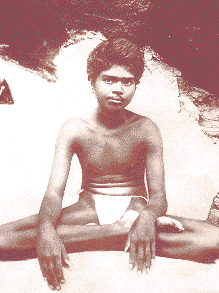
Another potential obstacle to Ramana's teachings is the shock that many feel on hearing about the neglect of his own well-being after the onset of the transformation. The idea that any positive inner transformation can lead to such loss of interest in life, to the point where rats are eating one's flesh, is almost unimaginable. The story is all the more poignant when we realise his age at the time, younger even than in the photo below.
We can understand the events in terms of via negativa, but also as a result of Ramana's unusual awakening, which came unannounced. The Buddha in contrast spent many years in active search for the same result, ironically only achieving it after renouncing the extreme asceticism he had been practising. Both men's teachings are via negativa, but we can only imagine that Ramana's awakening propelled him so rapidly into the bliss of eternal reality that it drove out any other considerations.
|
'Ramana's
entry into self-realisation was unanticipated and sudden. His life and
teachings represent the purest form of jnani via negativa transcendence,
but the lack of any effort or interest on his part prior to enlightenment
make his example problematic.'
|
Ramana's own transformation can be seen in terms of a radical shift of identity, from body to Spirit. As a body, one is ordinarily identified with a discrete, separate, and highly vulnerable fraction of the universe: one's energy is used in maintaining this fiction and in anxiously dealing with its needs, both physical and emotional, in a material and emotional world of limited resources. With the shift in identity from the body to the inner core of awareness the individual's investment of energy has shifted from the finite and temporal to the infinite and eternal. "I am not the body" sums up this shift, but as Ramana says so clearly, this is not a dull process of thought, but a living truth. This shift, for Ramana, seems to have taken place in the space of a few hours, and resulted in a permanent residence in the infinite and eternal. The lack of any peak experiences, visions, or manifest ecstasies, or any occult overtones whatever, makes Ramana's case more accessible to the secular mind than a man like Ramakrishna for example (who we will examine next).
Ramana's emphasis on association with Sages contains a paradox worth noting however : his own realisation was quite without any such association. This points to one of the universal problems of the spiritual life : that teachers often give advice that they never followed in the course of their own realisation. This should not be seen in a negative light however, but as a reminder that the idea of a 'path' is misleading, and is only a very rough metaphor at best. That is because one is 'travelling' to the place one never actually left, one's true nature.
Ramana's example leads one to speculate that there must be cases of self-realisation, where the individual becomes so wholly identified with the infinite and the eternal, that the desire to teach never asserted itself, so we never become aware of them.