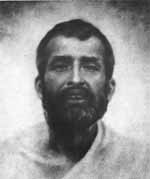
Sri Ramakrishna was born in 1836 in the Bengali village of Kamarpukur. He was an uneducated boy, with an early love for religious festivals and observances, and for acting in religious stories, often the woman's part. As a boy he watched a flock of swans fly up from a nearby lake, and lost consciousness in the first of many religious trances. He became a priest, and was offered a place at a Kali temple built by a rich devotee, but his parents were worried by his other-worldliness (even though both parents had a premonition before his birth of his spiritual stature), and arranged a marriage for him. The marriage had little effect, for they had to wait six years before consummation could be possible, and in any case they managed to choose as spiritual a girl as one could find for him, later to become revered in her own right as a teacher (Sarada Devi). By the time that they did come to live together both were so far on the spiritual path that consummation never in fact took place.
Romain Rolland gives an account of a formative stage in Ramakrishna's development, where his instinct for the devotional was challenged by an encounter with a formidable exponent of the path of non-dualism - a man known as Tota Puri from the Naga sect of Advaita Vedanta.
"The naked man, Tota Puri, taught me to detach my mind from all objects and to plunge it into the heart of the Atman. But despite all my efforts, I could not cross the realm of name and form and lead my spirit to the Unconditional state. I had no difficulty in detaching my mind from all objects with the one exception of the too familiar form of the radiant Mother [Kali], the essence of pure knowledge, who appeared before me as a living reality. She barred the way to the beyond. I tried on several occasions to concentrate my mind on the precepts of the Advaita Vedanta; but each time the form of the Mother intervened. I said to Tota Puri in despair: 'It is no good, I shall never succeed in lifting my spirit to the "unconditioned" state and find myself face to face with the Atman.' He replied severely: 'What! you say you cannot? You must!' Looking about him, he found a piece of glass. He took it and stuck the point between my eyes, saying: 'Concentrate your mind on that point.' Then I began to meditate with all my might, and as soon as the gracious form of the Divine Mother appeared, I used my discrimination as a sword, and I clove Her in two. The last barrier fell and my spirit immediately precipitated itself beyond the place of the 'conditioned', and I lost myself in Samadhi." …
"The Universe was extinguished. Space itself was no more. At first the shadows of ideas floated in the obscure depths of the mind. Monotonously a feeble consciousness of the ego went on ticking. Then that stopped too. Nothing remained but Existence. The soul was lost in Self. Dualism was blotted out. Finite and Infinite space were as one. Beyond word, beyond thought, he attained Brahman."
The meeting between Ramakrishna and Tota Puri is unusual in the history of the spiritual life because there seems to have been a mutual transmission : Tota Puri then learned the devotional from Ramakrishna. Each in turn became master, and each in turn came to 'understand' the path of the other, though understand is too mild a word to capture what took place between them. Though each probably remained true to their basic impulse or orientation (one to what we call 'awareness' — but also variously known as non-dualism, jnani, yoga, knowledge and so on — and the other to devotion) their secondary realisation of the other path gave them an unusual basis from which to teach. Ramakrishna is typical of the Indian renunciate, though his story is unique as this brief introduction has shown. Despite his realisation of non-dualism he taught devotion to the divinity Kali, and his students were allowed to express this as devotion to him. He in return delighted in the young men that come and shared his worship. He warned them against 'women and gold', and advised them to keep away from women until they were sufficiently pure for a woman to be no danger, much as a young tree is fenced around to prevent elephants damaging it, but when fully grown needs no fence. His teachings were full of these simple metaphors, part of his culture, but brought to life by the intensity of his personality and realisation.
The Gospel of Ramakrishna documents life at Dakshineswar, on the banks of the Ganges in what is now Bengal, and is a diary written by one of his devotees, modestly calling himself only 'M'. Aldous Huxley provided a foreword, calling Ramakrishna a saint, with the lucky provision of a competent reporter on his life. This is probably the first well-documented Indian mystic, and probably only because of the influence of the British, and it is a remarkable glimpse into the Hindu tradition of guru and disciple, and into life in nineteenth century India. Ramakrishna urged his listeners to surrender to divine love, to God-intoxication, while renouncing the pleasures of the world. Ramakrishna was quite happy to take 'householders' as disciples, urging them only to restrain their sexual demands on their wives. Ramakrishna seems to be so genuinely beyond the sexual (he admitted somewhere that physically it simply didn't work any more), that his advice has the ring of a warm recommendation rather than of moralising. His renunciation had quite a different nature to that of Gandhi, for example : there was no sense of struggle with himself; but on the other hand his only interest in the manifest world seemed to lie with his disciples and their potential for self-realisation. An issue that crops up again and again in M's Gospel is whether Ramakrishna was a 'divine' or ordinary incarnation. Ramakrishna himself offered no definitive view, though both his parents had intimations of a divine incarnation (though whether of Shiva or Vishnu is unclear). His refusal to be dogmatic is typical of the fluidity of all his thought, and his respect for all paths, shown in this quote:
"Greeting to the feet of the Jnani [seeker on the path of awareness (knowledge)]! Greeting to the feet of the Bhakta [seeker on the path of devotion]! Greeting to the devout who believe in the formless God! Greeting to those who believe in God with form! Greeting to the men of old who knew Brahman! Greeting to the modern knowers of Truth. …"
Christopher Isherwood was more certain that Ramakrishna's incarnation was special, as we see from this extract from his biography of Ramakrishna at the time near his death:
On August 13th, Naren [Vivekananda, discussed below] was again in Ramakrishna's room, alone. The body on the bed seemed barely alive and quite preoccupied with its pain. Could this abjectly suffering creature be an incarnation of God? 'If he would declare his divinity now, in the presence of death,' Naren said to himself, 'I'd accept it.' He was instantly ashamed of the thought and put it from his mind. For some moments he stood watching the Master's face intently. Then, slowly, Ramakrishna's lips parted and he said in a distinct voice, 'Oh Naren — aren't you convinced yet? He who was once born as Rama, and again as Krishna, is now living as Ramakrishna within this body — and not in your Vedantic sense.'
By adding 'not in your Vedantic sense' Ramakrishna was, of course, emphasising that he did not merely mean he was essentially the Atman, as is every being and object, according to Vedanta philosophy. Ramakrishna was explicitly declaring himself to be an avatar and an incarnation of former avatars. Isherwood was a devotee of Ramakrishna and may have been making too much of this conversation; Ramakrishna's statement here is not typical and may have been only said for the benefit of a particular disciple. For those seeking a justification of the perennial philosophy from a mystic, rather than from an academic, Ramakrishna is worth studying as he could see into the heart of all traditions and mystics and comment on their essential unity - from an experiential level. The initial encounter with Tota Puri, leading to his dissolving the boundaries of the devotional and the non-dual paths, became an active examination of all the traditions that he came across, including Christian and Moslem. Ramakrishna's embraciveness, present in its usual form of love and compassion for his students, was thus characterised by an additional and intense curiosity for any manifestation of the spiritual impulse in any culture or tradition.
Ramakrishna is also known for his disciple, Vivekananda, who, unlike his master who never travelled, went to the United States in 1983 and introduced Ramakrishna and Hindu thought to the West. His name previous to his departure for the States was Narendra (or Naren), and Ramakrishna had a presentiment of his arrival at Dakshineswar and the great role that lay ahead of him. The following passage describes this, but is also of interest as a description of Ramakrishna's inner world:
One day I found that my mind was soaring high in Samadhi along a luminous path. It soon transcended the stellar universe and entered the subtler region of ideas. As it ascended higher and higher, I found on both sides of the way ideal forms of gods and goddesses. The mind then reached the outer limits of that region, where a luminous barrier separated the sphere of relative existence from that of the Absolute. Crossing that barrier, the mind entered the transcendental realm, where no corporeal being was visible. Even the gods dared not peep into that sublime realm and were content to keep their seats far below.
But the next moment I saw seven venerable sages seated there in Samadhi. It occurred to me that these sages must have surpassed not only men but even the gods in knowledge and holiness, in renunciation and love. Lost in admiration, I was reflecting on their greatness, when I saw a portion of that undifferentiated luminous region condense into the form of a divine child. The child came to one of the sages, tenderly clasped his neck with his lovely arms, and addressing him in a sweet voice, tried to drag his mind down from the state of Samadhi. That magic touch aroused the sage from the superconscious state, and he fixed his half-open eyes on the wonderful child. His beaming countenance showed that the child must have been the treasure of his heart. In great joy the strange child spoke to him, 'I am going down. You too must go with me.' The sage remained mute but his tender look expressed his assent. As he kept gazing at the child, he was again immersed in Samadhi. I was surprised to find that a fragment of his body and mind was descending to earth in the form of a bright light. No sooner had I seen Narendra than I recognised him to be that sage.
The child in this passage is taken to be Ramakrishna himself. Narendra, like Arjuna, was of the warrior caste and physically and intellectually well-developed and of an acutely independent mind, but his first visit to Ramakrishna only persuaded him that the older man was eccentric, for Ramakrishna had recognised him from his vision and drawn him aside, to babble incoherently to him that at last he could 'pour out his spirit into the breast of somebody fitted to receive my inner experience!' Narendra returned however:
"I found him alone sitting on his small bed. He was glad to see me, and called me affectionately to sit near him on one side of the bed. But a moment later I saw him convulsed with some emotion. His eyes were fixed upon me, he muttered under his breath, and drew slowly nearer. I thought he was going to make some eccentric remark as on the previous occasion. But before I could stop him he had placed his right foot on my body. The contact was terrible. With my eyes open I saw the walls and everything in the room whirling and vanishing into nothingness.… The whole universe and my own individuality were at the same time almost lost in a nameless void, which swallowed up everything that is. I was terrified, and believed I was face to face with death. I could not stop myself from crying out, What are you doing? I have parents at home.…' Then he began to laugh, and passing his hand over my breast, he said, 'All right. Let us leave it at that for the moment! It will come, all in good time.' He had no sooner said these words than the strange phenomena disappeared. I came to myself again, and everything both outside and in, was as before."
Ramakrishna is Krishna to Vivekananda's Arjuna: also striking is the image of Ramakrishna placing his foot on him, as in so many images of the goddess Kali. Vivekananda's discipleship was troublesome but also 'nectar' for Ramakrishna, and later Vivekananda said of them both: "Outwardly he was all Bhakta, but inwardly all Jnani.… I am the exact opposite." The life of Ramakrishna helps us to understand the state of samadhi, an ecstatic state, which is considered to be either with or without content, and is described at length in the Yoga Sutras of Patanjali. We have many accounts of Ramakrishna's samadhi, one of which took place during a rare opportunity in front of a photographer, resulting in one of the best-known and best-loved photographs of the saint. In the photograph his hands are raised in a spontaneous gesture of bliss, and he has to be supported by one of his followers.
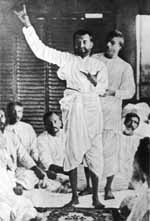
According to Rolland, Tota Puri himself was so awed by the body of Ramakrishna in samadhi 'rigid as a corpse for days on end', that this persuaded him to break his rule of only spending three days in any one place and resulted in him staying eleven months to learn from the man who had previously been his disciple. In the many accounts in M.'s biography, Ramakrishna said of his samadhi that they were empty of content: he lost consciousness of his surroundings and entered a state of pure consciousness. It is possible that Socrates' fits of abstraction were also of the same type, but (as will be outlined in the section 'jnani and the West') Socrates is clearly jnani in orientation. Ramakrishna's samadhis are those of a bhakti.
Ramakrishna died in 1886 of cancer of the throat. This affliction was often aggravated by Ramakrishna's love of singing, which played an integral part, along with dancing, in his devotions, and was much loved by his companions. His illness lasted nearly a year, during which Naren (Vivekananda) visited Bodhgaya, the site of the Bodhi-tree where the Buddha is said to have gained enlightenment. On his return they have an illuminating conversation about the Buddha, Ramakrishna repeating several times that the Buddha was not an atheist, while Naren shows increasing enthusiasm for his teachings, despite his interesting observation that the Buddha could not put into words what he had realised. Ramakrishna also commented that the Buddha or his path were to do with Pure Intelligence.
Ramakrishna's devotees often asked him, as his condition worsened, to pray to Kali to heal him, but he found that he could not. His state of surrender was so deep that, even for his disciples' sake, he found that his prayer simply could not contain any personal element, or request for intercession.
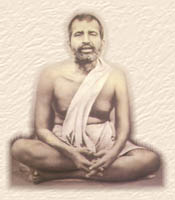
Ramakrishna's teachings are devotional, and as such may not directly illuminate the jnani path, condition, goal and orientation. He is a wonderful example of the highly developed bhakti, coupled with a breadth of interest and vision as shown in his understanding of jnani and his interest in all religious paths. However, as we saw in his comments on the Buddha, his instinct is always devotional, so his transcendence is always in terms of a God. His particular object of devotion was the Hindu goddess Kali, usually associated in the Western mind with destruction.
His teachings always encouraged the renunciative celibate life, advising withdrawal from all contact with 'women and gold' (or 'men and gold' for woman devotees), although he was happy to instruct the householders as much as the renunciates. The via negativa of Ramakrishna is perhaps the one that is most easily recognised, the simple concept that to pursue transcendence one needs to turn away from an active engagement with the world. At the same time it was not a life-threatening neglect of the basic needs of the body, as was the case with the early experience of Ramana Maharshi.
His teaching always returned to the need to fill one's heart and mind with the deity, appealing to it as a child does to its mother. The attitude of surrender and helplessness, along with a purity of heart, is sufficient for the deity to respond and bring the devotee to the profundity of the spiritual life. Above all this path has passion and warmth, alongside which the jnani orientation looks cold and dry. Ramakrishna regularly passed into devotional ecstasies, known as the state of samadhi, which his devotees felt accorded them special blessings, and as such were an important part of his teaching.
If one finds Ramakrishna's ecstasies and tearful devotions quite foreign, or even to indicate a lesser kind of spirituality, then consider this quote:
I and mine — that alone is spiritual ignorance. It ignores Reality in favour of personal and collective ego. Right now, invoke your most penetrating insight! If only for a moment, you will realize what you call I-consciousness to be fundamentally none other than limitless, timeless awareness. Look clearly! Are you really this body? Are you really this culturally conditioned mind? If you are uncompromising, you will inevitably recognize that you are none of these habitual structures. You will sense spontaneously that you have never been the originator or the performer of any action whatsoever. You are sheer awareness, free from routines, free from both faults and virtues. You cannot be essentially characterized as righteous or unrighteous, as liberated or bound.
This could easily be a passage from Ramana Maharshi, or for that matter, other great jnanis like the Buddha or Douglas Harding. Yet in fact it is a quote from Ramakrishna, cited in Great Swan, Meetings with Ramakrishna, by Lex Hixon. However powerful Ramakrishna's entire personal gestalt is for the devotional, his ability to articulate the case of the jnani is remarkable.
For the jnani however must remain the question, how much of Ramakrishna's experience of the reality of his chosen deity, Kali, is a matter of the imagination? Vivekananda often remonstrated with his Master that seeing God or Kali was all down to the imagination, reinforcing the idea for us that Ramakrishna must have had a profound intuition of Vivekanada's merit, as on the surface of it he seems a poor disciple. We also find in Ramakrishna's case elements that could be defined as occult (using the definition here), as in an extract quoted earlier where he enters various 'higher' or disembodied realms. We have noted before that the same question arises in connection with the entire occult, as Dion Fortune for example is ready to admit in her 'Mystical Qabalah'.
Ramakrishna is also a good example of a Master who's whole happiness depended on the quality of his devotees or aspirants, and his best-known disciple, Vivekananda, was very important to him.
Ramakrishna represents a highly-evolved bhakti, showing that the path of devotion can lead to the most profound knowledge of self, or to the deepest spiritual experience. Having said that the cultural context and chosen deity of Ramakrishna are foreign to the average Westerner, even if his devotional emphasis is more readily understood in the West than the jnani spirituality. If one can enter his life and times however then such a study is very rewarding. As with Ramana Maharshi, he illuminates the scriptures of ancient India, rather than the other way round, though in Ramakrishna's case it is always with a devotional emphasis. The prejudices that one might have as a Westerner about guru-worship are tested here, in that Ramakrishna accepted and encouraged devotion to himself in the form of salutations, gifts, and homilies, all of which are foreign to us if not downright suspect. Reading how this is carried out on a daily basis in M's Gospel of Ramakrishna gradually brings home however that the Indian context ensures that this is a light-hearted and benign practice, particularly brought home in the way that Vivekananda seems to participate in the guru-worship at times, and at others disagree with the very tenets of Ramakrishna's spiritual life. It is the sheer breadth of Hindu spiritual tradition that makes this possible, and more than anything, the acceptance that the jnani individual approaches the divine in a valid but quite different way to the bhakti individual. It is mainly through Ramakrishna's testimony that one might accept that the samadhi of a bhakti is in essence the same as the samadhi of a jnani.
|
'Ramakrishna
represents the highly-evolved bhakti or devotional spiritual Master.
We are particularly indebted to Ramakrishna for his ability to illuminate
the jnani-bhakti dichotomy for us, in his encounter with Tota Puri,
with his relationship with Vivekananda, and in the many discourses that
touched on the subject.'
|
While a study of Ramakrishna through the available texts undoubtedly deepens one's understanding of the spiritual life, there may be little chance to experience the blessings of such a Master at first hand. His 'classical' approach to via negativa is also mostly unsuited to the modern world. The rejection of 'women and gold' belongs to another era, one that is however common to both East and West.
We can sum up by saying that we are particularly indebted to Ramakrishna for his ability to illuminate the jnani-bhakti dichotomy for us, in his encounter with Tota Puri, with his relationship with Vivekananda, and in the many discourses that touched on the subject. He also shows us that devotion or prayer, while in its lowest form is not much more than a plea for intercession in the difficulties of one's life, becomes in its highest expression incapable of pleading even for one's very survival. It expresses a true oneness with the Universe.