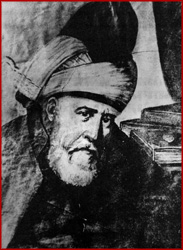
Mevlana Jelaluddin Rumi was born on 30 September 1207 in Balkh (in present day Afghanistan). He died on 17 December 1273 in Konya, Turkey, where his tomb and a monastery of the whirling dervishes are to be found to this day. Both Rumi's places of birth and death are significant in the spiritual history of the region; Balkh for being where Zoroaster is reputed to have died, and Konya the place where Ibn Arabi, another great Sufi, taught for a while. In 1219 Rumi's father took the family on a long journey away from the threat of the Mongol hordes of Genghis Kahn, settling in Anatolia, firstly in the city of Karaman. On the journey the young Rumi is supposed to have been introduced to the great Sufi poet Attar, who presented him with a copy of his Book of Mysteries and said of the young Jelal: "This child is destined to set the hearts of many aflame". Rumi's father, a theologian and mystic, was called to a post in Konya in 1228, and after his death Rumi took over as religious teacher there to a small community.
Some sixteen years later, having studied the writings of other Sufi masters, particularly Sana'i and Attar, and by all accounts leading a religious life within the conventions of his time and place, Rumi's life was to be transformed by the encounter with a God-intoxicated wanderer called Shamsi Tabriz. Rumi says of him "The God which I have worshipped all my life appeared to me today in human form." Rumi was thirty-seven at that time, and devoted himself completely to his new friend, to the ire of his family and community. Shams left after a while and was murdered on his return (the story is not entirely clear) after which Rumi embarked on his Herculean poetic masterpiece, the 30,000 verses of the Divan-i Shamsi Tabriz, his song for his lost friend. Rumi appears to have been transformed (at the age so typical in the lives of many great Masters) into a Master in his own right. The later poetry of the Mathnawi is dedicated to his closest disciples.
Rumi's fame spread and Sufis came from all over the region to meet him. After his death in 1273 his pupils organised the Mevlana or Mevlevi Order of The Whirling Dervishes, which has as its head a direct descendent of Rumi to this day. Dr. Celaleddin Bakir Celebi, the 21st generation successor and 32nd family member to hold the post of head of the order died only recently.

Rumi's teachings need to be set against the background of Sufism, often described as the mystical heart of Islam. Sufism appeared as a movement in the 10th century and is said to have drawn on pre-Islamic traditions including Neoplatonism and Buddhism. For us this would imply a jnani strand in what presents itself in the first instance as a fiercely devotional spiritual path. In fact we find this in Rumi's verses hidden amongst the outpourings of love; indeed even the great structural jnani Douglas Harding often quotes him in support of his entirely unsentimental understanding of Self. Sufism has a history predating the 10th century however and it has an early martyr in the Sufi Master, Mansur al-Hallaj. Already established as a spiritual teacher al-Hallaj travelled to Northern India in 905 where he would have been exposed to Vedantic traditions, and possibly Buddhist ideas. He returned to Baghdad but in 912 was arrested and executed for the heresy of proclaiming identity with God. This calamity was the background to the relationship between Sufi spirituality and the Islam of the mullahs, and many Sufis were subsequently persecuted, as were Christian mystics under the Catholic Church.
In India the pronouncement 'Atman is Brahman' means that the individual has found their identity with the Absolute, or God, and the statement and all variations upon it were never considered heretical in Hindu, Jain or Buddhist traditions. What marks out the Sufi tradition is that its goal was no less than 'Atman is Brahman' (expressed by al-Hallaj as 'an'l Haqq' or 'I am He'), despite the persecution that it brought. The Christian mystics who expressed the same idea were persecuted to the same degree or more, but their common revelation never was allowed sufficient expression to became a tradition. Hence the very idea is quite foreign to Western thinking today.
In this context it is easier to see why Rumi wrote in allegorical style, allowing him to express his identity with the Beloved without incurring the wrath of the authorities. Like many devotional Masters he used the metaphor of the lover to describe his relationship with the Absolute or God. To the secular mind the mingling in his poems of the relationship he had with Shams and the relationship he had with God is a matter of confusion, and even in Turkey and Iran today many assume that Rumi's poetry alludes not to a spiritual but to a homosexual love. While spiritual friendships between male Masters and their disciples may be a fascinating topic, it is not the point of Rumi's poetry.
To extract a doctrine out of Rumi's vast outpourings is also to miss the point however. To read them over a period of time is to let them do their work on one's heart, for any that can feel him. An immersion in his poetry does bring out common themes however, but the one overarching one is love, love, love. To quote just one of his poems is to ignore 130,000 others but this quite chance selection may just illustrate Rumi's special power:
Oh lovers, lovers, it is time
to set out from the world.
The drum of celestial distances
sounds in my soul's ear.
The camel driver is at work
and has prepared the caravan.
He asks that we forgive him
for the disturbance he has caused us,
but why are we travellers asleep?
Everywhere the murmur of departure,
and the stars, like candles
thrust at us from behind blue veils.
and as if to make the invisible more plain,
a wondrous people have come forth.Beneath this water-wheel of stars
your sleep has been heavy.
Observe that heaviness and beware...
for life is fragile and quick.
Heart, aim yourself at Love!
Friend, discover the Friend!
Watchman, wake-up!
You weren't put here to sleep!
Noise and alarm on every side,
candles and torches, tonight
this pregnant world gives birth to eternity.
Lifeless clay is living heart.
The inept become aware.
What draws you now
will lead you further,
and as it draws you to itself,
what pleasure your suffering becomes.
Its fires are like water,
do not tense your face.
To be present in the soul is its work,
and to break your vows.
By its complex art these atoms
are trembling in their hearts.Oh vain puppet proclaiming
your importance from a hole,
how long will you leap?
Humble yourself, or they will break you!
You have tended seeds of deceit
and practised contempt.
Oh pimp, the eternal truth
was cheapened in your hands!
Oh ass, you deserve only straw,
and were better black like the pot.There is another within me
by whom these eyes sparkle.
If water scalds it is by fire,
let this be understood.
I have no stone in my hand,
no quarrel with anyone.
I rebuke no man, but possess
the sweetness of the rose-garden.
My eye is from that source
and from another universe.
One world on this side, another on that,
as I sit on the threshold.
On the threshold are they alone
whose language is silence.
Enough has been uttered,
say no more, hold back the tongue.(Translated by Edmund Helminski)
This poem contains many images resonant of the Middle East, and also many symbolic elements of Sufism and Islam. The poem starts by telling us that we are lovers, and that it is time to set out from the world; the camel driver is at work. Most likely the 'camel driver' is Shamsi Tabriz, but it could equally well by Rumi himself or any spiritual Master telling us to turn inwards. We note that the 'camel driver' is polite, and the imagery of 'murmurs of departure' is likewise gentle (though evocative for anyone on the spiritual path). He goes on to remind us that we are asleep (spiritually) and that it is time to wake up, and that 'this pregnant world gives birth to eternity'. Our suffering is a fire that does its work in the soul, a sentiment that Richard Rolle, the great medieval English bhakti would have agreed with. Rumi then chastens us, comparing our base nature to that of a pimp or ass. He finishes however with an exquisite description of what it is like to find God within one. Firstly it is by Him that one's eyes sparkle, and to emphasise the transmutation of man into God he uses the metaphor of water which does not scald through itself but through the agent of fire. He tells us that he possesses the sweetness of the rose-garden (a common Sufi metaphor) and then returns to the theme of his eyes. By saying that 'my eye is from that source and another universe' he is effectively pointing to the Witness that perceives through all our senses, and then finishes with the metaphor of a threshold. Quite simply this threshold is the interface between the manifest and the unmanifest, and Rumi, as with all enlightened beings, finds himself sitting at that interface. In one poem then, Rumi encompasses love, suffering, the departure from 'this' world, our 'sleep' to the divine reality, our baseness, and finally to the relationship with God. The last sentiment, that of sitting at the threshold, stripped of the emotion of love, is simply what Douglas Harding has taught for fifty years, and where the great bhakti and the great jnani are one and the same.
But Rumi ends the poem with a plea for silence. How can such a magnificent poet plead for the death of his art? Simple. He was foremost a Master, and only secondly a poet. This is shown in the reputed exchange between Rumi and one of his disciples, who asked for more poems. The great Master replied that his poetry was only tripe, but if that is what his guests demanded, then he could only bow to them and provide it.
In the introduction to Edmund Helminski's short collection of Rumi's verse he says that the West has no convenient category for Rumi. In the terminology of this site we do however, and describe him as a fully realised bhakti. So far we have presented Ramakrishna as the only example of the fully enlightened bhakti Master, but Rumi in fact has a greater presence and following round the world. Unlike Ramakrishna who was an uneducated village boy, Rumi was a theologian and scholar, though transformed by his encounter with Shams. He was also a brilliant poet. The resulting verse is extraordinary because it combines the direct experience of the bhakti with a highly educated mind and literary gifts. While Ramakrishna could express the relationship between jnani and bhakti through his tradition and homespun metaphor, Rumi interpenetrates the divine longings of his heart with the intellectual sophistication of the Buddha. But, for the Buddha the term 'sober' would be synonymous with Enlightenment, while for Rumi it would be 'drunk' — a difference of metaphor that goes to the root of the jnani / bhakti divide. In the Sufi tradition intoxication and sobriety are terms of great importance and refer to two types of love for God. The true Sufi rejects any artificial intoxicant, Rumi for example saying this:
They place upon themselves the shame
of hashish and opium.
To escape for an instant
the shackles of existence.
To be God-intoxicated however is not to escape existence but to reach its very heart.
|
'While Ramakrishna
could express the relationship between jnani and bhakti
through his tradition and homespun metaphor, Rumi interpenetrates the
divine longings of his heart with the intellectual sophistication of the
Buddha.
|
It is interesting to compare Rumi with Whitman. Both were great poets with substantial oeuvre, and both (we contend) were great spiritual Masters, one bhakti, the other jnani. Both have an overtly celebratory element to their poetry, both have acquired the 'solid prizes of the Universe'. Both men hid their meanings within the language of poetry (though Rumi less so), and both had disciples. The great difference was that Rumi hid his meaning because of the intense interest in the spiritual in his time, whereas Whitman hid his meaning because of the indifference of his age. The nineteenth century American context was one where the modern spirits of that age stood for secularism and democracy, though they may have had a private religion; the thirteenth century middle-Eastern context was one of feudalism and open piety. Rumi was also part of a tradition, and already served as cleric before his transformation, but Whitman, despite his Quaker background, pursued a spiritual life so democratic and secular that his spiritual genius is now unrecognised.
In terms of our distinctions Rumi is clearly a transcendent bhakti, and shows again that the fully realised bhakti is no less or more than the fully realised jnani. But what of our via positiva / via negativa distinction? Rumi in fact brings a whole new dimension to this discussion because his verse often explicitly deals with another Sufi idea, that of expansion and contraction. Expansion is a state of grace and takes place when God turns to the supplicant; contraction is when He departs. Essential to the bhakti way is dependence on grace, and when it is denied the bhakti is in a state of longing or contraction. Even when the Beloved is present there is the dread of loss, but this depends a great deal on personality. The Sufis have an extraordinary story about Jesus and John the Baptist, that Jesus never wept and John never smiled. When they met John said to Jesus: "O Jesus, have you become secure from being cut off from God?" Jesus replied "O John, have you despaired of God's mercy? Your weeping will not change the eternal decree, nor will my laughter alter His foreordainment." (Nowhere in Western Christianity is Jesus found laughing!)
Rumi taught that expansion and contraction were a natural rhythm like the seasons. In expansion energy is expended, and in contraction it is again regenerated, much like a garden that needed winter because without it the summer sun would burn up its beds to the very roots. This gives us another way of looking at via positiva and via negativa, that they too can intertwine in one's spiritual life like the seasons.