|
 |
 |
||
|
Good
Science and 9-11 Demolition Theories |
 |
||
 |
|
|||
|
This
paper is written to demonstrate that those who believe that the World
Trade Centre was destroyed by controlled demolition, rather than the
impact of the planes, are mistaken. While I sympathise with the overall
aims of protesting against US and UK foreign policy, I don't believe
that US officials took part in a conspiracy to murder thousands of their
fellow-citizens. I believe that the truth is in fact more alarming:
US and UK foreign policy is based on ignorance, not malice. But I don't
believe in fighting ignorance with ignorance. However well-intentioned,
the demolition theories will not achieve their goals because they are
based on an ignorance of good science.
|
|
Good
Science and 9-11 Demolition Theories
Mike King Latest revision:
13 May 2007
1.2
The Counter-Orthodoxies and Counter-Counter-Orthodoxies 1.4
Jones’s Scientific Evidence and the Science and Practice of Demolition 1.5
Some Basic Concepts in Physics 2.1
Molten Metal: Flowing and in Pools 2.2
Observed Temperatures around 1000°C and Sulfidation in WTC 7 Steel 2.3
Near-Symmetrical Collapse of WTC 7 2.4
No Previous Skyscraper Collapse Due to Fires 2.5
Squib-timing during the Collapse of WTC 7 2.6
Early Drop of North Tower Antenna 2.7
Eyewitness Accounts of Flashes and Loud Explosions 2.8
Ejection of Steel Beams and Debris-plumes from the Towers 2.9
Rapid Collapses and Conservation of Momentum and Energy 2.10
Controlled Demolition “Implosions” Require Skill 2.11
Steel Column Temperatures of 800°C Needed:
A Problem in the Argument of Bazant and Zhou 2.12
Problems in the NIST Report: Inadequate
Steel Temperatures and Tweaked Models 2.13
NIST's Failure to Show Visualizations 3
Additional Arguments for the CD Hypothesis 3.2
Energy Required to Pulverise Concrete 3.4
Sudden Onset of Collapse ‘Consistent with Demolition’ 3.5
Core Columns ‘Should Have Remained Standing’ 3.6
Explosions in the Sub-Basement 4
David Ray Griffin and the Dustin Mugford DVD
1 Introduction
1.1 Background
The events of 9/11 are widely recognised to be a defining factor in the early unfolding of world history in the 21st century. From this single audacious attack on the US, conflicts in Afghanistan and Iraq flow directly, along with terrorist attacks on Madrid, Bali, and London. Arguably the July 2006 war in Lebanon and the Gaza Strip, waged between Israel on the one side, and Hamas and Hezbollah on the other, is also shaped by the aftermath of 9/11. Domestic and foreign policies of most of the world’s nations have changed as a direct consequence of the attack. Hence it is of great interest to many different groupings to ascertain the truth of the 9/11 attacks. Broadly speaking there exists the official line, generated by various US Government sponsored investigations, and the counter-orthodoxy, comprising a range of views. On the official side there are three key reports: 1. FEMA (Federal Emergency Management Agency) 2. NIST (National Institute of Science and Technology) 3. 9/11 Commission Broadly speaking these reports agree that a group of 19 Muslim men, armed only with box-cutters (penknives), hijacked 4 domestic flights, three of which hit their intended targets, and one of which crashed in a field after passengers fought back. AA flight 11 crashed into the North Tower of the World Trade Centre (WTC); UA flight 175 crashed into the South Tower of the WTC; and flight 77 crashed into the Pentagon. The official theory holds that planes which hit the Twin Towers caused structural damage on impact, stripped away insulation from steel columns and severed water sprinklers; caused fires to rage; and eventually they collapsed causing widespread destruction to many other WTC buildings, and, later in the day, the complete collapse of building WTC 7. Those adhering to the various counter-orthodoxies do not accept that 19 Muslim men, armed only with box-cutters, could achieve such destruction, and believe that the events were part of an official conspiracy. In this paper I will focus mainly on the claims that the Twin Towers and WTC 7 were destroyed by controlled demolition (as part of this conspiracy), rather than the result of the impact of the planes and the subsequent fires. My aim is to show that the scientific basis for these claims is weak or non-existent. Mostly I will avoid using the loaded term ‘conspiracy theory’ for the counter-orthodoxy, partly because the official account is also, of course, a conspiracy theory. Instead I will use the term ‘controlled-demolition-theory’ or just ‘CD theory’ for the counter-orthodoxy, and the term ‘impact-fire-theory’ or just ‘IF theory’ for the official account, where they deal with the collapse of the WTC buildings. 1.2 The Counter-Orthodoxies and Counter-Counter-Orthodoxies
But who are the groups or individuals challenging the official account? In this paper I focus on a single scientist, Steven Jones, whose work is widely cited by CD theorists, to support their wider challenge to the official line. Another key figure is philosopher and theologian David Ray Griffin, whose two books on the subject are amongst the most radical, and effectively accuse a range of US officials of mass murder. Whole organisations exist however to challenge the official account, including:
The events of the day, and the technical details surrounding them are immensely complex, and the counter-orthodoxies have thrown up a wide variety of objections to the official line. I will focus mainly on the controlled-demolition theories, and in particular at the science behind them. What is interesting is that a range of individuals and groups are attacking the counter-orthodoxies, and presenting scientific arguments that refute them. I urge anyone who believes that the argument is merely between the official line and the counter-orthodoxies to look at the following sources which independently argue against the counter-orthodoxies:
I will draw on the scientific points of the above sites and papers where appropriate. I want to add here that I think that the publication of books and the existence of websites all devoted to the counter-orthodoxies – which effectively accuse the US Government in general, and range of individuals in particular, of mass murder of fellow-US citizens – are a tribute to Western principles of democracy and freedom of expression. By the same token I am free, along with others, to publish works that challenge the counter-orthodoxies. I want to make it absolutely clear however that I do not support the US Government in its response to 9/11. I simply believe that the approach taken by those who accuse it of complicity in the attacks is misguided. I believe that these accusations will founder on a lack of evidence, and that the same energy could be used to work, using democratic principles, to show where Bush and his colleagues have really gone wrong. I believe this to be their blanket refusal to learn about Islamic culture, history, and tradition; in particular their failure to credit radical Islamic movements their valuable and popular socialist and welfare dimensions; and their attempt to impose Western values on Islamic countries by force. If you doubt my anti-Bush credentials, please visit
a site I created to honour the civilians of Afghanistan killed by US
bombing in its subsequent campaign: www.thetwintragedy.org.
I greatly regret not continuing work on this, but I believe that Professor
Marc Herold, who supplied most of the statistics,
has continued in his efforts to make known that fact that approximately
the same number of innocent Afghan civilians died in the US-led invasion
as did US civilians in 9/11. 1.3 Motivation
I have spent my academic life researching the intersections between art, science and religion, and have not been drawn up to this point to contemplate in any detail the events of 9/11. However two friends and colleagues have been deeply persuaded of the counter-orthodoxy, principally by Griffin, and to some extent Jones, so I emailed some initial comments objecting in general terms to what I saw, and still do, as a ‘conspiracy theory’ of the worst kind. When I say ‘worst kind’ I mean that the theory betrays the fundamental principles of what I hold good science to be. My first degree was a joint honours in Physics and Chemistry, and later on I completed an MSc in Software Engineering and have written hundreds of thousands of lines of code for big graphics programmes. Jointly these experiences have persuaded me that ‘Good Science’ is a matter of slow and careful investigation of data, with the continual awareness that one’s own emotional commitment to one result or another tends to make it overwhelmingly tempting to jump to conclusions ahead of the due process. Debugging large software programmes is very similar to the detective work in crime investigations, only one is personally the ‘criminal’ and even more likely to have an investment in one’s theories. Looking at the writings of those challenging the official line, I find little evidence of good science in this sense: it seems that the individuals promoting these ideas are already persuaded of their version of the ‘truth’. My interest in 9/11 is therefore partly personal – I am hoping to dissuade my friends of their adherence to the counter-orthodoxies – and partly that I believe in ‘Good Science’ as the basis for much more than academic arguments over the interpretation of events. I believe in ‘Good Science’ as fundamental to what we cherish, though often without naming them such, as ‘Enlightenment Values.’ 1.4 Jones’s Scientific Evidence and the Science
and Practice of Demolition
In Section Two I will focus on the scientific evidence put forward by Professor Steven Jones in his online paper at http://www.physics.byu.edu/research/energy/htm7.html entitled “Why Indeed Did the WTC Buildings Collapse?” He presents his evidence under 13 headings, though in fact some include additional points, and some are effectively subsumed under other headings. His evidence is meant to convince us that the Twin Towers and WTC 7 were brought down by controlled demolition, meaning the use of explosives triggered in a sequence similar to that used in legitimate explosive demolition. The bulk of this paper is devoted to Jones’s 13 headings, showing in detail why I think he is wrong on every count. I believe, as a scientist, that Jones’s principal error is not to research the science and practice of explosive demolition. It is quite understandable when lay persons repeat the oft-cited 9/11 opinion: ‘it looked like controlled demolition.’ A good example is Hollywood actor Charlie Sheene recounting his reaction to 9/11 in a TV interview: ‘I said, “call me insane, but did it sorta look like those buildings came down in a controlled demolition?”’ (You can see this in a DVD distributed by one of the counter-orthodoxy groups, 911revisited.com at www.911revisited.com; I comment on the DVD in section Four of this paper.) But it is the job of a scientist not to be fooled by appearances: a scientist knows that fool’s gold isn’t gold and the leaf-moth isn’t a leaf. A physicist also knows well that much of physics is deeply counter-intuitive, for example that heavy bodies fall at the same speed as light ones, that the earth rotates, is round, etc. I will now sketch an outline of the science and practice of explosive demolition, though the finer points will become apparent in the arguments to follow. First of all, the art of bringing a tall building down by the use of explosives is not a widely disseminated field of engineering, being rather the specialist domain of a few dozen top international companies, often family-run. Hence there are not many books on the subject, and the Internet now is more likely to point to Jones’s paper on the subject than any useful technical review. However, the web site How Stuff Works (http://science.howstuffworks.com) has a short section on explosive demolition that is informative, and begins with this description: The
basic idea of explosive demolition is quite simple: If you remove the
support structure of a building at a certain point, the section of the
building above that point will fall down on the part of the building
below that point. If this upper section is heavy enough, it will collide
with the lower part with sufficient force to cause significant damage.
The explosives are just the trigger for the demolition. It's gravity
that brings the building down. The key physics is elucidated here: that it is gravity which brings the building down. More than that, it is gravity that smashes concrete walls and floors into rubble, and it is gravity that is responsible for the sometimes vast clouds of dust and debris that billow out from the site. The explosives used have a marginal additional effect in converting the structure into rubble and dust: their job is to cut supports, often in a carefully timed sequence. Brent Blanchard puts it like this: 'Since their inception in the late 1800s, blasting engineers have understood that building implosions work best when the forces of gravity are maximised. This is why blasters always concentrate their efforts on the lowest floors of the structure. While smaller supplemental charges can be placed on upper floors to facilitate breakage and maximize control as the structure collapses, every implosion ever performed has followed the basic model of obliterating structural supports on the bottom few floors first, "to get the structure moving."' Two types of explosive demolition are carried out: ‘toppling’ and ‘implosion’. Toppling involves the placing of explosive charges to cut out the support structure on one side only of a building, causing the structure to rotate as it collapses, generally into an open lot where it can do no damage. Implosion involves the more symmetrical placing of charges in order to bring the building down symmetrically into its own ‘footprint’. It is the near-symmetrical collapse of the Twin Tower and WTC 7 that has drawn many lay observers to the belief that they were brought down by controlled explosive demolition – ‘implosions’ that could only be achieved by very skilled operators. Unfortunately for the CD theorists the skilled operators – those in the business of carrying out implosions on contracts worth millions of dollars – don’t share this belief. 1.5 Some Basic Concepts in PhysicsReaders can skip this for now, but I want to outline some very simple and fundamental concepts in physics needed to negotiate the scientific claims and counter-claims of the IF and CD theories. (I promise that this is very brief and easily accessible to the lay person.) The first is that when an object is raised to a height, it gains what is known as gravitational potential energy. As Loizeaux says: “Every nail that was carried up in the pocket of some construction worker is potential energy that’s at our disposal, …” In terms of physics the potential energy is calculated by the formula E = mgh E is the energy, m is the mass (of the nail or any other object), g the acceleration due to gravity, and h the height that the object is raised. If m is in kilograms, g in metres per second per second, and h in metres, then E is measured in a unit called Joules. When the Loizeaux family demolish a building in an implosion they are liberating this stored potential energy as kinetic energy – the energy of movement. This energy is calculated by a different formula: E = ½ mv2 In this case the kinetic energy in Joules is equal to half the mass of the moving object times the velocity squared. When the collapsing building hits the ground the kinetic energy is converted into other forms, such as fracture energy (energy required to break, for example, concrete into rubble), sound energy, and heat energy. To give some pertinent examples, the gravitational potential energy (mgh) of one of the Twin Tower has been estimated at 1.139 x 10¹² Joules. This is roughly 1 followed by 12 noughts or a billion times a billion Joules (an American trillion). To put that in perspective, it is roughly the same energy as 272 tons of TNT exploding, or enough to melt one thousand metric tonnes of steel. The impact of the faster of the two planes released kinetic energy (½ mv2) roughly equal to 4 x 1009 Joules, or four thousand million Joules. This is enough to melt approximately 4 metric tonnes of steel. Of course, the energy released by the collapse of the Towers or the impacts of the plane did not go into melting tonnes of steel (though a small fraction may have). The point here is to understand the colossal energies involved in the WTC disaster, and how they are estimated in physics. Also vital to understand is the law of conservation of energy, which requires that all the energy that disappears in one form must appear in an other form or forms. We will see that a key debate in the IF vs. CD theory is as to whether there was enough gravitation potential energy (mgh energy) in the buildings to account for the pulverisation of them into such fine dust and rubble. It is also helpful to be able to compare the mgh energy of the buildings to any proposed energy that the CD theorists believe to have come from explosives. The additional scientific concept that needs to be introduced is more nebulous, but critical: it is complexity theory (also broadly called chaos theory). While pure physics (of the kind that Newton’s revolution in science introduced to the world) deals with very simple systems, the real world is not just a bit more complicated: it is orders of magnitude more complicated. Newton was able to make his stunning breakthrough in astronomy (in brief, the inverse square law of gravitation) because he focussed on two bodies at a time, i.e. the sun and any given planet, or a planet and its moon. It is well known in physics that the introduction even of a third body to the problem makes the mathematics almost intractable. If we scale up the problem to a natural event like the collapse of the Twin Towers, then we are dealing with a vast number of bodies interacting with each other. Chaos theory tells us a very sobering fact about a complex system like this: minute variations in the input factors for a complex system lead to wildly varying outcomes. This is why explosive demolition is part science, but also part art. Like all experts in real-world events, implosionists are masters of their total body of experience, constituting what influential writer Donald Schon has called ‘tacit knowledge.’ When CD theorists cite as evidence that ‘no steel-framed building has ever collapsed before as a result of fire’ they are ignoring complexity theory, which requires only that small differences in the original parameters result in a novel outcome. The question we shall explore is whether the impact of a passenger jet into a steel-framed building makes that ‘small’ difference or not. 1.6 What is Good Science?For me, good science is far more than accurate science. ‘Accurate representation’ for philosopher Richard Rorty is ‘simply an automatic and empty compliment which we pay to those beliefs which are successful in helping us do what we want to do.’ [Rorty, Richard, Philosophy and the Mirror of Nature, Princeton, New Jersey: Princeton University Press, 1979, p. 10] I find this quintessentially postmodern approach to science not just inadequate but actually painful: my love of science has been lifelong and born out of its extraordinary ability to penetrate the world of appearances and find laws whose predictive powers are the basis of our modern technological lifestyles. More than just ‘helping us do what we want to do’ however, I believe that the birth of science with Newton and others was the genuine basis for the Enlightenment and the values that flowed from it and which are the basis of what is best in the modern world. Above all, science taught the great thinkers of the Enlightenment that there was a way beyond personal prejudice and superstition in the settling of the affairs of society, a way of settling dispute based on evidence. Difficult as this path is, there lies an even more important lesson from science: when the evidence is not available then we are obliged to say: we don’t know. Science is not often promoted as the discipline which teaches us what we don’t know, but for me that is the essence of good science. The Witchfinder General only allowed the possibility that the accused man or woman was a witch or was not. ‘We don’t know’ was not an option, and the most absurd evidence was concocted to fill the vacuum. For us to really know something in science we have to start with a simple system, isolate it from variables that enter from outside, and above all, be able to repeat the phenomenon under scrutiny. The WTC attack is as far removed from this as one can get. Only identical structures under identical impacts could form the basis for certain knowledge as to whether or not the impacts could cause the collapses. But when we examine both the wilder and the more sober adherents to the counter-orthodoxies and to the controlled demolition theory, we find a universal unwillingness to accept that ‘we don’t know’ what happened. Not at least with the kind of certainty available to the phenomenon in controlled laboratory experiments. The most common complaint from the counter orthodoxy is ‘I can’t believe that …’ followed by a specific from the event. For example eye-witness accounts confirm that after impact on WTC 2 a blast blew out windows in the ground floor lobby and hurled people to the ground. The official account suggests that the kerosene-air mixture from the impact zone high up in the tower was forced down the lift shafts and other ducting by a fireball, causing the damage. Martin Sheene, speaking in the same TV interview, said: ‘I have a hard time believing that a fireball travelled down the elevator over 1100 feet and still had the explosive energy to destroy the lobby like it was described.’ One can sympathise with this point of view, but good science goes beyond pub talk like this: it starts by not pre-judging. Instead it investigates. I need to make another point on good science here: the question of publication in refereed journals. The CD theorists are largely drawing on unpublished scientific papers. There is of course good science that is refused publication, and there is of course bad science that does get published, but these are exceptions, and on the whole what publication means is that experts in the field have checked the assumptions, experimental procedures, calculations, and flow of the argument that make up the paper. Even the most polymathic of scientists find this difficult to do outside of their own discipline. 2 Jones’s Evidence Refuted
This section refers to Professor Steven Jones’s paper, widely available on the Internet, for example at: http://www.physics.byu.edu/research/energy/htm7.html. It is worth having this to hand in following the arguments in this section. I have used his thirteen section headings verbatim. Jones gives a summary of his argument at the beginning of his paper, but I will start with the detailed arguments in the sections that follow the summary. 2.1 Molten Metal: Flowing and in Pools
Eye-witness accounts of the presence of molten metal at high temperatures in the basement rubble of the Twin Towers and WTC7 have led Jones to speculate that the industrial compound thermite was responsible, and is hence evidence for the CD theory. Jones: “I maintain that these observations are consistent with the use of high-temperature cutter-charges such as thermite, HMX or RDX or some combination thereof, routinely used to melt/cut/demolish steel.” But thermite is an incendiary, a vastly different product to HMX and RDX which are military explosives like TNT that can be used in civilian demolition projects. Thermite is a slow-burning product in comparison, does not explode, and, as far as I can determine, is never used in demolition of buildings. It can be used to melt horizontal pieces of steel, because it produces molten iron at up to 2,500 degrees centigrade, which flows onto the target and melts it. It cannot be used to melt vertical structures, because the molten iron simply flows past the target. Thermite is used to quietly destroy military equipment such as artillery (by inserting it down an up-pointing barrel), but more regularly in construction, for example, to weld rails together. Hence the CD theory is not supported by the quantities
of molten metal, because thermite in its conventional
form is useless in demolition: it is slow-burning, with unpredictable
time to melt, and can only be used in direct contact with horizontal
unclad steel beams / components. (The horizontal steel members in the
Twin Towers were covered by at least 4 inches of concrete.)
Prototype thermite cutter torches have been developed which could cut
steel at any angle, but they work by producing as stream of high-velocity,
high-temperature combustion products. Any iron produced by such a cutter
would be dispersed as as droplets and would only in exceptional circumstances
pool into any significant quantities of molten iron. It is more likely
that a film of iron particles, mixed with aluminium oxide particles,
would be deposited on nearby surfaces. However this is speculation on
my part as I cannot find any reference to commercially available thermite
cutter torches. If anyone can provide information on such devices I
would be pleased to hear from them. Nano-thermites, mentioned by Jones,
are also ruled out because they operate more like an explosive, and
so would disperse iron particles as I suggest above. The thermite lance,
a variant that uses a long iron tube with aluminium rods running through
it, is ruled out as far as I can tell because it would require an operative. Jones: “Observe the grayish-white plumes trailing upward from white "blobs" at the left-most extremities of the upper structure. (The lower structure is mostly obscured by dust.) It is possible that thermite cut through structural steel and that what we now observe is white-hot iron from the reaction adhering to the severed ends of the steel, with grayish-white aluminum oxide still streaming away from the reaction sites. The observations are consistent with the use of thermite or one of its variants.” In the photograph provided there is only one white blob on the left-most extremity of the upper structure. Grayish white plumes seem to come from the whole structure, not the blob, and could be any kind of ash or powder. There is no significant resemblance either to the plumes emitted from the bag of thermite in Jones’s accompanying photo. Indeed the plumes in the WTC photo are indistinguishable from the billowing clouds of dust and debris around them. More easily visible, and the subject of debate, is the stream of what looks like molten metal running from WTC 2 just below the impact zone. Jones: “Who can deny that liquid, molten metal existed at the WTC
disaster? The yellow color
implies a molten-metal temperature of approximately 1000 oC,
evidently above that which the dark-smoke hydrocarbon fires in the Towers
could produce. If aluminum
(e.g., from the plane) had melted, it would melt and flow away from
the heat source at its melting point of about 650 oC
and thus would not reach the yellow color
observed for this molten metal. Thus,
molten aluminum is already ruled out with high probability.” To rule out aluminium so quickly is poor science, because we don’t know what the temperatures were in the impact zone, while we do know that many metric tonnes of aluminium constituting the plane were in the area just above the outflow of molten metal. Of course, the alternative hypothesis, that the molten metal was iron or steel, should be also considered carefully. The argument of Jones is that if the molten metal were steel, then it would support the CD theory. But the link between molten steel and controlled demolition is non-existent, as thermite is not used in controlled demolition. Hence Jones requires a variation on controlled demolition: controlled demolition plus the use gratuitous and incompetent use of thermite. We have to believe that the conspirators had researched controlled demolition so badly as to decide on the use of thermite. Now, Jones estimates that “Roughly 2,000 pounds of RDX-grade linear-shaped charges” would be sufficient to bring the building down, and such a quantity of explosive might conceivably have been hidden in each of the towers. But the quantity of thermite required to produce this stream of molten metal is much greater. 107 Kg of thermite is required to produce 54 Kg of molten iron, and the stream of molten metal flowing from the impact zone (if iron) has been estimated at thousands of kilograms. Even if the stream is only 1,000 kg of iron, then 2,000 kg, or two metric tonnes, of thermite would be required. But the CD hypothesis implies much more than this. For a start the thermite would have been distributed over the proposed target floor for initial collapse, so it would be very difficult for the molten iron products to pool in one place and pour out. Secondly, the CD hypothesis agrees that the floor(s) of impact of the plane could not have been exactly predicted, so every, say, 5 floors, another couple of metric tonnes of thermite would be required. (Jones: ‘… to make it appear that the planes somehow initiated the collapse; cutter-charges could have been pre-placed at numerous spots in the building, since one would not know exactly where the planes would enter.’) Even if only the top half of the building were so prepared, then we would anticipate 2 metric tonnes x 11 locations or 22 tonnes. If the mass of stream of molten metal were estimated at more like 10,000 kg of iron then the figure goes up to 220 tonnes of thermite. We have to believe (a) that the conspirators were ignorant enough to attempt to use thermite, and (b) could insinuate between 22 and 220 tonnes of thermite, plus charges, plus radio firing systems, into each tower. If in addition, thermite is required by the CD hypothesis to account for the molten steel in the basement after collapse, then we have to add an addition two tonnes of thermite for every tonne of molten iron. The problem for the CD theory is in fact that no reliable estimates exist of the amount of molten metal, if any, in the basements. To sum up, it is a tough job to for the CD hypothesis to account for the stream of molten metal as iron produced from thermite reaction because (a) the choice of thermite requires the conspirators to be incompetent, (b) pooling of the molten iron would require the odd concentration of thermite on a given floor in one location, and (c) the quantity needed (22-220 tonnes) would be hard to smuggle in and hide in the building. This quantity increases by two tonnes per every tonne of molten steel estimated to be in the basements. The IF hypothesis suggests that the molten metal is aluminium (and other alloys used in plane construction), and that it pooled in that location because that is where the plane was. As Jones rightly point out however, the IF hypothesis would require the molten aluminium (and alloys) to attain temperatures several hundred degrees above melting point. The IF hypothesis also requires that the molten steel in the basement have been heated by a combination of fire and mgh energy, so much rests on estimates of those factors. I want to add a hypothesis that may yet explain the high temperatures, and would need to be disproved by the CD theorists: that some of the aluminium in the planes was ignited on impact. I return to this issue later on. 2.2 Observed Temperatures around 1000°C and
Sulfidation in WTC 7 Steel
In Jones’s second section, he continues on the themes of high temperatures: Jones: “combines aluminum/iron oxide (thermite) with barium nitrate (29%) and sulfur (typically 2% although more sulfur could be added). The thermate reaction proceeds rapidly and is much faster than thermite in degrading steel leading to structural failure. Thus, both the unusually high temperatures and the extraordinary observation of steel-sulfidation (Barnett, 2001) can be accounted for -- if the use of thermate is allowed in the discussion.” I would suggest that the argument against thermite I presented above applies equally to thermate. Certainly, the sulfidation of steel is an additional argument in favour of thermate, but is mitigated against because of the difficulty of maintaining contact between thermate sulphur-rich molten-iron products and steel columns. Molten iron flows very fast, due to its high density, and would have only very short contact times with vertical steel members, which would have had to have their insulation previously stripped. We are left again with the issue of the thermite / thermate molten iron products perhaps pooling on an exposed horizontal steel member long enough to cause melting and sulfidation, unlikely because the horizontal members were covered in at least 4 inches of concrete. Jones says: “While gypsum in the buildings is a source
of sulfur, it is highly unlikely that this sulfur
could find its way into the structural steel in such a way as to form
a eutectic.” But why is this more unlikely than with thermate?
Jones needs to present evidence that steel girders or columns, when
exposed to burning thermate, result in sulfidation,
and that the high temperatures and pressures of the collapse could not
achieve sulfidation with the sulphur contained in gypsum (plaster).
There are certainly interesting scientific questions here to which we
don’t know the answers. But our ignorance is equal as to the two proposed
processes, so at present we should marginally favour the theory that
has a known source of sulphur: the gypsum. You may like to look at the ‘Rethinking Thermite’
pages on the Debunking 911
site for further arguments against Jones’s hypothesis (www.debunking911.com/thermite.htm).
2.3 Near-Symmetrical Collapse of WTC 7
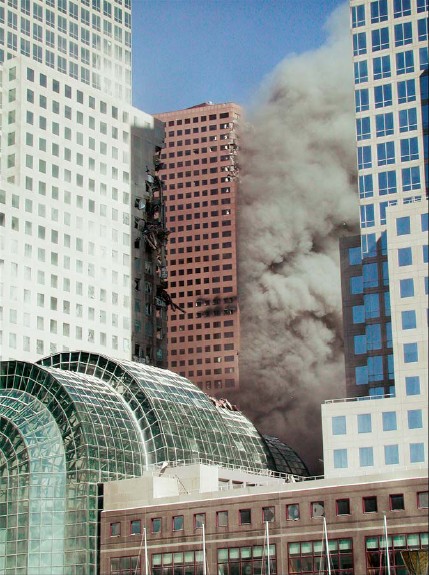
The collapse of WTC 7 building, which was not hit by planes is one of the more enduring mysteries of 9/11. The counter-orthodoxy argues that a 47 story steel-framed building with small falling debris damage and low-grade fires burning for only 7 hours should not have collapsed. Suspicions are also fuelled by the fact that NIST has yet to complete its report on the building. Jones draws attention to one of the features of its collapse: Jones: “WTC 7 collapsed rapidly and nearly-straight-down symmetrically -- even though fires were randomly scattered in the building. WTC 7 fell about seven hours after the Towers collapsed, even though no major persistent fires were visible (considerable dark smoke was seen). ” I believe that the near-symmetry of the WTC 7 collapse is overstated in the CD theories. An aerial view of the site after collapse shows the north façade of the building neatly folded on top of the rubble, suggesting that the front of the building, which had received severe damage, collapsed ahead of the rear, which had no damage. As the front of the building fell, it pulled the rear down on top of the debris. It is also rather vague to say that “no major persistent fires were visible” – such a statement does not lead to quantifiable assessments of thermal heat production or temperatures. The photograph below shows the ‘considerable dark smoke’ pouring from the building: is this not due to a major fire?
I am indebted to the Debunking 911 site for this image, and recommend reading the entire page devoted to this issue: www.debunking911.com/pull.htm. The face of the building (WTC 7 is the pink-coloured one) from which smoke is pouring is the south face damaged by debris falling from WTC 1. (I recommend watching the video of WTC 7 burning, available on the same webpage.) But in any case why should we accept from Jones that “no major persistent fires were visible” even if this has become the mantra of the counter-orthodoxy? Wouldn’t the eye-witness testimony of experienced New York firefighters count for more? Captain Chris Boyle (Engine 94) with 18 years of service with the FDNY gave this interview: Firehouse: Did that chief give an
assignment to go to building 7? Boyle: He gave out an assignment.
I didn’t know exactly what it was, but he told the chief that we were
heading down to the site. …
We
went one block north over to Greenwich and then headed south. There
was an engine company there, right at the corner. It was right underneath
building 7 and it was still burning at the time. They had a hose in
operation, but you could tell there was no pressure. It was barely making
it across the street. Building 6 was fully involved and it was hitting
the sidewalk across the street. I told the guys to wait up. A
little north of Vesey I said, we’ll go down,
let’s see what’s going on. A couple of the other officers and I were
going to see what was going on. We were told to go to Greenwich and
Vesey and see what’s going on. So we go there
and on the north and east side of 7 it didn’t look like there was any
damage at all, but then you looked on the south side of 7 there had
to be a hole 20 stories tall in the building, with fire on several floors.
Debris was falling down on the building and it didn’t look good. But
they had a hoseline operating. Like I said,
it was hitting the sidewalk across the street, but eventually they pulled
back too. Then we received an order from Fellini,
we’re going to make a move on 7. That was the first time really my stomach
tightened up because the building didn’t look good. I was figuring probably
the standpipe systems were shot. There was no hydrant pressure. I wasn’t
really keen on the idea. Then this other officer I’m standing next to
said, that building doesn’t look straight. So I’m standing there. I’m
looking at the building. It didn’t look right, but, well, we’ll go in,
we’ll see. So
we gathered up rollups and most of us had masks at that time. We headed
toward 7. And just around we were about a hundred yards away and Butch
Brandies came running up. He said forget it, nobody’s going into 7,
there’s creaking, there are noises coming out of there, so we just stopped.
And probably about 10 minutes after that, Visconti,
he was on West Street, and I guess he had another report of further
damage either in some basements and things like that, so Visconti
said nobody goes into 7, so that was the final thing and that was abandoned.
Firehouse: When you looked at the
south side, how close were you to the base of that side? Boyle: I was standing right next
to the building, probably right next to it. Firehouse: When you had fire on the
20 floors, was it in one window or many? Boyle: There was a huge gaping
hole and it was scattered throughout there. It was a huge hole. I would
say it was probably about a third of it, right in the middle of it.
And so after Visconti came down and said nobody goes in 7, we said all
right, we’ll head back to the command post. We lost touch with him.
I never saw him again that day. http://www.firehouse.com/terrorist/911/magazine/gz/boyle.html Here is an extract from the testimony of Deputy Chief Peter Hayden, who had 33 years service in Division 1 to his credit: Firehouse: Other people tell me that there were a lot of firefighters in the street who were visible, and they put
out traffic cones to mark them off? Hayden: Yeah. There was enough there and we were marking off. There were a lot
of damaged apparatus there that were covered. We tried to get searches
in those areas. By now, this is going on into the afternoon, and we
were concerned about additional collapse, not only of the Marriott,
because there was a good portion of the Marriott still standing, but
also we were pretty sure that 7 World Trade Center
would collapse. Early on, we saw a bulge in the southwest corner between
floors 10 and 13, and we had put a transit on that and we were pretty
sure she was going to collapse. You actually could see there was a visible
bulge, it ran up about three floors. It came
down about 5 o’clock in the afternoon, but by about 2 o’clock in the
afternoon we realized this thing was going to collapse. Firehouse: Was there heavy fire in there right away? Hayden: No, not right away, and that’s probably why it stood for so long because
it took a while for that fire to develop. It was a heavy body of fire
in there and then we didn’t make any attempt to fight it. That was just
one of those wars we were just going to lose. We were concerned about
the collapse of a 47-story building there. We were worried about additional
collapse there of what was remaining standing of the towers and the
Marriott, so we started pulling the people back after a couple of hours
of surface removal and searches along the surface of the debris. We
started to pull guys back because we were concerned for their safety. www.firehouse.com/terrorist/911/magazine/gz/hayden.html I believe that the testimony of experienced fireman ought to give most sober-minded people very serious doubt about the CD hypothesis, in particular the account of the sagging of the building prior to collapse, the assertion by Hayden that it was a heavy fire, and the testimony regarding lack of water pressure to fight the blaze. Boyle’s report suggested that the debris caused a huge
gash of twenty storeys in that face, which would allow for the flow
of air to the fires simply unprecedented in fires in similar buildings. All the evidence suggests that WTC 7 was unique in the history of fire-fighting because (a) structural damage was extensive, (b) vast openings in the south face allowing unimpeded airflow, (c) water mains had been severed by the collapse of the Towers, and hence almost no water was available to the Fire Service, and (d) the Fire Service had anyway made the eminently reasonable policy decision that their priority was to save lives not buildings, so it burned for 7 hours virtually unattended. Also, the bulging of the building prior to collapse is also prime evidence against the CD theory, because controlled demolition never produces such bulges. In this section Jones also wants to argue that the fine rubble produced in the WTC 7 collapse is evidence of explosives: Jones: By contrast, concrete floors in the Twin Towers and WTC 7 were pulverized to dust -- as is common in controlled demolitions using explosives. But we have already pointed out that concrete floors,
if they are pulverised to
dust in controlled demolition, are pulverised due to gravity, not explosives.
This is a core mistake repeated by Jones and other CD theorists. 2.4 No Previous Skyscraper Collapse Due to
Fires
This is one of the leading arguments in favour of the CD hypothesis, and the counter argument states that no previous skyscraper had been hit by an airliner. In the case of WTC7 the counter argument goes that it (a) it suffered severe structural damage from falling debris, and (b) fires raged for 7 hours in it, with no significant fire-abatement effort. In the differing cases of the towers and building 7, the IF theory has to show that structural damage (including insulation displacement) plus fire is an adequate account. Hence the CD theorists must present evidence to show that the IF account is inadequate, by denying the magnitude of both the structural damage, and the intensity of the fires. Too much of the argument either way on this issue is mere opinion, so the best science here is to return to issues that have a clearer empirical basis. 2.5 Squib-timing during the Collapse of WTC
7
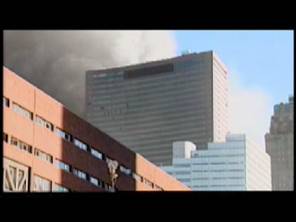
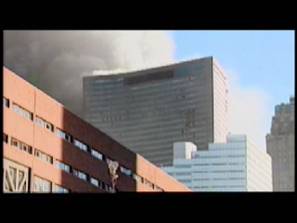
For many CD theorists, the ejection of puffs of smoke and other debris during collapse is a sure sign of the use of explosives. Jones: “Horizontal puffs of smoke and debris are observed emerging from WTC-7 on upper floors, in regular sequence, just as the building starts to collapse. (The reader may wish to view the close-up video clip again.) The upper floors have evidently not moved relative to one another yet, from what one can observe from the videos. In addition, the timing between the puffs is less than 0.2 seconds so air-expulsion due to collapsing floors (see Chertoff, 2005) is evidently excluded. Free-fall time for a floor to fall down to the next floor is significantly longer than 0.2 seconds: the equation for free fall, y = ½ gt2, yields a little over 0.6 seconds, as this is near the initiation of the collapse.” Jones is referring to videos of WTC 7 collapse which show dark markings on the right of the top of the building, as in the 2nd image below. They are nothing like as regular in sequence as he proposes, and he uses video footage which focuses in just on the top right instead of the whole building. In the two frames below it is clear that dark markings appear erratically over the building, and in no sequence that could possibly suggest controlled demolition.
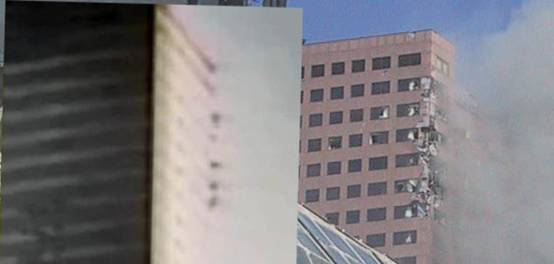
The Debunking 911 site devotes a page to this at www.debunking911.com/overp.htm where it is suggested that the specific locations of the dark markings Jones refers to is in fact due to impact damage on that corner of the building:
I am grateful to the Debunking 911 site for this image, and the suggestion that we are looking at damaged panels flapping about, rather than at ‘squibs.’ The photograph of the damage to WTC 7 so high on the building also helps us understand the extent of the damage to the whole of the south façade, which we do not apparently have other photographic records of. In the video the upper ten or so storeys are moving downwards as one, so air-expulsion originating from within these floors is ruled out, but not because of the timings Jones cites. Instead, it is obvious that if there was air-expulsion of debris and fine dust would be generated by the pancaking taking place far below, rather than within these levels. The ‘puffs’, travelling up the ten or so storeys visible in the video could not come from the upper storeys, but could come from pressure build up below expelling material up a shaft or stairwell, and out horizontally where there were open corridors or other relatively unimpeded flow ways, or, more simply, as Debunking 911 says, causing previously damaged panels to flap about. It would be impossible to put the timing constraints that Jones suggests on these ‘squibs’ because one would need a precise hydrodynamic model of the overpressures working their way through the collapsing structure. Jones: “However, the presence of such “squibs” proceeding up the side of the building is common when pre-positioned explosives are used, as can be observed at http://www.implosionworld.com/cinema.htm The same site shows that rapid timing between explosive squibs is also common.” Jones is right to say that “rapid timing between explosive squibs is also common” (often down to microseconds) but he fails to notice the much bigger timing issue in controlled demolition. Any detonations on upper floors are designed, not to bring the building down, or accelerate its progress, but to ‘teach’ the building how to collapse, once it starts descending. As such, the explosions on upper floors take place in the fractions of seconds prior to the main descent of the building, not during it. Jones also appears to believe that such ‘squibs’ running up a building are common, as if it confirms for him that demolition proceeds by progressively cutting away floors in a progressive upward fashion. This is simply not true, necessary, or possible in conventional explosive demolition. Jones would also need to account for the overall pattern of dark patches appearing across the building as it descended, which he ignores. Jones: “Thus, squibs as observed during the collapse of WTC 7 going up the side of the building in rapid sequence provide additional significant evidence for the use of pre-placed explosives.” Even by using the term ‘squib’ Jones has pre-judged the hypothesis, because ‘squib’ means firework or explosive. The puffs of smoke are however no evidence of controlled demolition, because controlled demolition simply does not require explosive charges to go off at this point, and in such a sequence. The timing and sequence can, however, be explained by the ejection of debris in the crumple zone at the base of the building, and the huge build-up of pressure forcing the material upwards through shafts (or new cavities emerging during collapse) and being forced out as the material progressively shoots upwards. Alternatively the ‘squibs’ are merely damaged panels flapping about, perhaps moving due to pneumatic pressures from pancaking. The supposed existence of ‘squibs’ in the Twin Towers is also cited as evidence for the CD theory, but, as Debunking 911points out on its squib page, the ejecta generally increase in intensity over time, as one would expect from pneumatic effects. Explosives are defined by the fact of the incredibly short time in which their blast wave spreads, quite unlike the spurts in the Twin Tower videos. Returning to WTC 7, Popular Mechanics interviewed a NIST official and reported as follows: NIST's Sunder
tells PM. "On about a third of the face to the center
and to the bottom--approximately 10 stories--about 25 percent of the
depth of the building was scooped out." NIST also discovered previously
undocumented damage to WTC 7's upper stories and its southwest corner. NIST
investigators believe a combination of intense fire and severe structural
damage contributed to the collapse, though assigning the exact proportion
requires more research. But NIST's analysis
suggests the fall of WTC 7 was an example of "progressive collapse,"
a process in which the failure of parts of a structure ultimately creates
strains that cause the entire building to come down. Videos of the fall
of WTC 7 show cracks, or "kinks," in the building's facade
just before the two penthouses disappeared into the structure, one after
the other. The entire building fell in on itself, with the slumping
east side of the structure pulling down the west side in a diagonal
collapse. According
to NIST, there was one primary reason for the building's failure: In
an unusual design, the columns near the visible kinks were carrying
exceptionally large loads, roughly 2000 sq. ft. of floor area for each
floor. "What our preliminary analysis has shown is that if you
take out just one column on one of the lower floors," Sunder notes,
"it could cause a vertical progression of collapse so that the
entire section comes down." There
are two other possible contributing factors still under investigation:
First, trusses on the fifth and seventh floors were designed to transfer
loads from one set of columns to another. With columns on the south
face apparently damaged, high stresses would likely have been communicated
to columns on the building's other faces, thereby exceeding their load-bearing
capacities. Second,
a fifth-floor fire burned for up to 7 hours. "There was no firefighting in WTC 7," Sunder says. Investigators believe
the fire was fed by tanks of diesel fuel that many tenants used to run
emergency generators. Most tanks throughout the building were fairly
small, but a generator on the fifth floor was connected to a large tank
in the basement via a pressurized line. Says Sunder: "Our current
working hypothesis is that this pressurized line was supplying fuel
[to the fire] for a long period of time." This text is available at: www.popularmechanics.com/science/defense/1227842.html?page=5&c=y.
Note that we are, as of August 2006, still awaiting the NIST report
on WTC 7: it may well throw up new data. 2.6 Early Drop of North Tower Antenna
I am particularly puzzled why Jones thinks that the ‘early’ drop of the North Tower antenna points to controlled demolition: Jones: “The building stood for more than an hour and a half. Videos of the north tower's collapse appear to show that its television antenna began to drop a fraction of a second before the rest of the building. The observations suggest that the building's steel core somehow gave way first… (Glanz and Lipton, 2002; emphasis added) But how? What caused the 47 enormous steel core columns of this building which supported the antenna to evidently give way nearly simultaneously, if not cutter charges?” Jones commits, not so much an error of science here, as an error in logic. The IF theory requires the ‘47 enormous steel core columns’ of the building to give way first, due to structural damage and fire. The CD theory requires that cutter charges do the job. But the early drop of the North Tower antenna is consistent with either theory. Therefore Jones cannot claim that this phenomenon supports only the CD theory. It is also not clear why he wants to call it an ‘anomaly’ other than perhaps to discredit the IF theory by stealth. When records from east and west vantage points were viewed, it was apparent that the building section above the impact area tilted to the south as the building collapsed. (NIST, 2005) Jones: However, we find no quantitative analysis in the report which shows that this tilting of the building section was sufficient to account for the large apparent drop of the antenna as seen from the north, or that this building-section-tilting occurred before the apparent antenna drop. Furthermore, the FEMA investigators also reviewed "videotape recordings of the collapse taken from various angles" yet came to the sense that "collapse began with one or more failures in the central core area of the building." (FEMA, 2002) Quantitative analysis needs to be done and shown to resolve the issue. All that Jones is doing in this statement is to re-iterate the challenge to the IF theory to account for the collapse of the central columns. The early descent of the antenna lends no additional support to the CD theory whatsoever, though at the same time it does not contradict it. Put more simply: it is a red herring. 2.7 Eyewitness Accounts of Flashes and Loud
Explosions
The CD theorists draw a lot on eyewitness testimony from non-experts. Jones: ‘Multiple loud explosions in rapid sequence were heard and reported by numerous observers in and near the WTC Towers, consistent with explosive demolition. Firemen and others described flashes and explosions in upper floors near where the plane entered, and in lower floors of WTC 2 just prior to its collapse, far below the region where the plane had struck the tower (Dwyer, 2005). For instance, at the start of the collapse of the South Tower a Fox News anchor reported: “There is an explosion at the base of the building… white smoke from the bottom… something happened at the base of the building! Then another explosion.” (De Grand Pre, 2002, emphasis added.)’ When Jones says that ‘explosions’ were heard, he is, like with the word ‘squib,’ using language that implies a pre-judgement. A more neutral and scientific term would be ‘loud report’ possibly consistent with explosions. To say that these reports were ‘multiple loud explosions consistent with explosive demolition’ (my italics) is to further lead the reader. But has Jones taken the trouble to play the interviewees audio tapes of controlled demolition to see how closely the reports resemble the detonation of typical explosives used in demolition? Such explosives detonate with a signature ‘crack’ quite different to the loud reports that can be generated from a host of other phenomenon. Aviation fuel, spilling through the building and building up pockets of fuel-air mixtures in confined spaces, would detonate as a stray spark reached them from the fires above. It is known that floors collapsed prior to the main descent of the buildings: the sounds of steel buckling and breaking, and of concrete smashing onto lower floors, would all emit loud reports. Many other objects and devices commonly found in skyscrapers would explode when exposed to fires of up to an hour and a half: has Jones made any study of this in connection with conventional fires? The issue of loud reports issuing from ground or lower floors is in fact inconsistent with the CD theory. This is because the building collapsed from the top, not the bottom, and hence the CD theory itself would rule out the placing of charges at the lower floors. The CD theory of the twin towers collapse has to be a theory of top-down demolition. This is recognised by 911 Review (which promotes the CD theory) in a webpage called “DISTRACTION: 'Explosions in the Towers' Basements Preceded Collapses'” The pages states: The idea that powerful explosions in the Towers' basements initiated the collapses is not supported by credible evidence, but is contradicted by large bodies of evidence. We note: · The conclusions that seismic spikes preceded the collapses is based on flawed analysis. · The body photographic and video evidence contradicts the idea that large explosions in the Towers' bases precipitated the collapses. · The testimonies of emergency responders do not include descriptions of large-scale explosions low in the towers preceding the descent of the dust clouds. (www.911review.com/errors/wtc/basementbombs.html) Brent Blanchard devotes section 4 of his paper to refuting the claim that eye-witness heard the sound of explosives. He says: 'Simply put, there are countless causes of sharp, loud noices that have no relation to explosives. The only scientifically legitimate way to ascertain if explosives were used is to cross reference the fundamental characteristics of an explosive detonation with independed ground vibration data recorded near Ground Zero on 9/11.' I’ll return to the issue of seismic spikes, and why these eliminate the possibility of explosives, in section 3.3. 2.8 Ejection of Steel Beams and Debris-plumes
from the Towers
Jones: “The horizontal ejection of structural steel members for hundreds
of feet and the pulverization of concrete to flour-like powder, observed
clearly in the collapses of the WTC towers, provide further evidence
for the use of explosives – as well-explained in http://911research.wtc7.net/talks/towers/index.html. (See also, Griffin, 2004, chapter 2.) The observed plumes or "squibs" are
far below the pulverization region and therefore deserving of particular
attention. They appear much like
the plumes observed in http://www.implosionworld.com/cinema.htm (e.g.,
the controlled demolition of the Southwark Towers).” The CD hypothesis is somewhat self-contradictory here, in that much is made of the collapse of the towers into a small area as evidence of ‘skilled’ controlled demolition. On the other hand the ‘horizontal ejection of steel members’ which spread the debris well beyond the footprint of the building is also cited as evidence of CD. But careful observation of controlled demolition shows that much material is ejected horizontally at the point of pancaking, i.e. in the crumple zone. This ejection is not caused by explosion but by the huge pneumatic overpressures of the descending building. The Towers, unusually, had a crumple zone very high up, making the horizontal ejection of material uniquely visible. While explosives could have caused this, so could the pneumatic pressure of descent of the upper floors. In WTC 1 there were between 12 and 18 stories collapsing onto the impact area between floors 94 and 98, while in WTC 2 there were between 26 and 32 stories collapsing onto the impact area between floors 78 and 84. If one views the base of a 12-18 story building or a 26-32 story building being demolition in a traditional bottom-up demolition, vast amounts of debris are ejected at this point. (To put it in perspective the tallest building ever demolished by controlled explosions is 25 storeys.) The issue of pulverisation is also crucially misunderstood. By far of the bulk of pulverisation that takes places in a controlled demolition is not due to explosives, but due to the free-fall descent of the building. The plumes referred to by Jones (called ‘mysterious’ in the caption he provides next to the photo illustrating them) could be caused by explosives. Equally the enormous pneumatic overpressures caused by the collapse above them (involving a greater mass at this point in the descent than in any controlled demolition in history) could easily have forced material ahead of them to blow out of any weakest route made possible by the combination of vertical shafts and horizontal corridors. All of the observed phenomenon, as Jones points out, could be the result of explosions. But equally, all of them are consistent with gravity-powered collapse, once begun. It is also important to note that much of the dust produced would have been from plaster, a material that disintegrates far easier than concrete. The NIST findings confirm that gypsum (the main ingredient of plaster) was widely found in the debris. 2.9 Rapid Collapses and Conservation of Momentum
and Energy
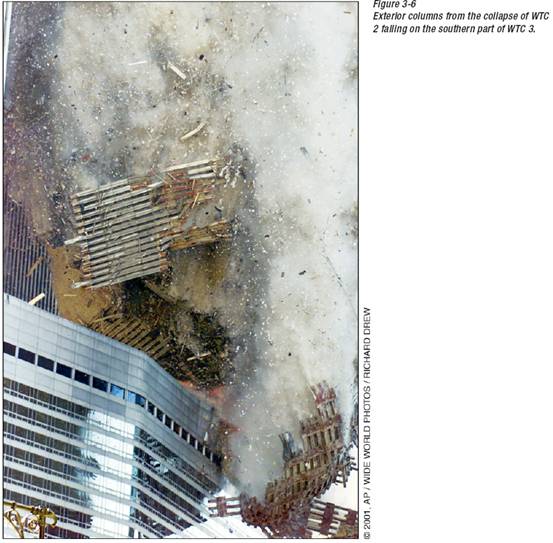
Jones: “How do the upper floors fall so quickly, then, and still conserve momentum and energy in the collapsing buildings? The contradiction is ignored by FEMA, NIST and 9-11 Commission reports where conservation of energy and momentum and the fall-times were not analyzed. The paradox is easily resolved by the explosive demolition hypothesis, whereby explosives quickly remove lower-floor material including steel support columns and allow near free-fall-speed collapses (Harris, 2000).” To many people the apparent collapse of the buildings at ‘near free-fall-speed’ is one of the most compelling arguments in favour of the CD theory. However it is also the most easily dealt with on scientific grounds. The fact is that the near free-fall-speed of collapse of buildings in controlled demolition is entirely due to gravity, and not to explosives. The question of course remains, how come that buildings, impeded by their intact lower floors, collapse so fast? (Though of course, this is not a question with any direct relevance to 9/11.) Put this way, the question conveys the essential fact of controlled demolition: that the only floors effectively ‘removed’ from the building are the lowest. (Further charges are placed in the building if and only if it is necessary to guide its fall in a certain way, for example to collapse a building into its footprint.) In a 20-story building, for example, the bottom floor or floors is extensively rigged with explosive, to remove its load-bearing capability. The remaining 18-odd storeys pancake into the region of the destroyed floor, one at a time, raising exactly the same question as to how is it that this process can take place so quickly? The same question applies to conventional demolition, and to the Tower buildings. The difference is that the pancaking occurs high in the Twin Towers (‘top-down pancaking’), and at the base of WTC 7 (‘bottom-up pancaking’). In the usual bottom-up process each floor impedes the process of collapse through its structural rigidity, just as much as one would expect in the top-down processes in the Towers. Although no text-book account is available which might give a simple answer to the issue of the speed of gravitational collapse of buildings, one might draw on the analogy of a hydraulic press compressing, say, a car body shell. The car body shell may seem strong enough to withstand everyday loadings, but, when it takes the hit of a high-powered press, it collapses with astonishing speed. 18 storeys of a big building, moving even rather sedately as they would at the onset of collapse, probably outstrip the forces of even the biggest hydraulic press ever built. It seems that all the proponents of the CD theory state the case, like Jones above, along the lines: “The paradox is easily resolved by the explosive demolition hypothesis, whereby explosives quickly remove lower-floor material including steel support columns and allow near free-fall-speed collapses.” This is simply unscientific; not corresponding to the reality of how controlled demolition is carried out. Returning to our example of the collapse of a 20-story building, there is simply no need to explode each floor, and such explosions are certainly not the explanation of why buildings fall so fast in controlled demolition. All the calculations produced by the CD theorists, designed to prove their theory, are based on the wrong premise, that explosions accelerate the descent. They don’t: it is purely gravity that does it. Jones: “We observe that approximately 30 upper floors begin to rotate as a block, to the south and east. They begin to topple over, not fall straight down. The torque due to gravity on this block is enormous, as is its angular momentum. But then – and this I’m still puzzling over – this block turned mostly to powder in mid-air! How can we understand this strange behavior, without explosives?” Jones seems to believe that a 30-story section of the building was “turned mostly to powder in mid-air,” through the use of explosives. He ignores the fact that large sections of the building, such as this, did fall, and were responsible for destroying or partly destroying other WTC buildings. Although considerable disintegration of the 30-story block was inevitable as it impacted on the rest of the South Tower, the bulk of the pulverisation would have been on impact on the WTC complex. Here is a photo of a large chunk of WTC 2 falling onto WTC 3, which was almost totally destroyed by debris falling from the Towers. This fragment shows a different orientation to the section described by Jones, which suggests that angular momentum was conserved.
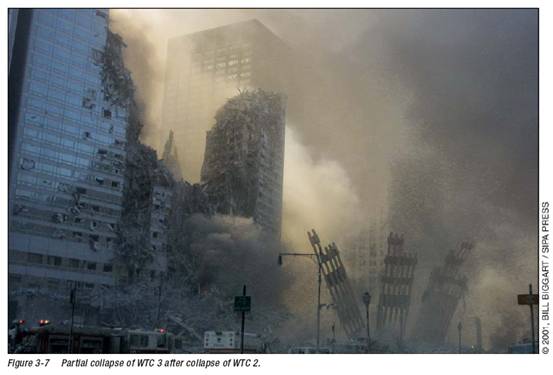
The next photo shows the destruction wreaked on WTC 3 by debris falling from WTC 2.
This photo was taken after the collapse of WTC2 and before the collapse of WTC1, half an hour later. It must surely lay to rest the idea that the Towers were blasted to bits in mid-air. Only large chunks of falling debris, as shown in the previous photo, could cause this kind of destruction. But anyway, to truly explode a 30 story building in
mid-air would be an astonishing feat of pyrotechnics, and would also
beg the question: why bother? But if Jones is serious, the estimate
of the amount of explosives required, in metric tonnes, would be staggering,
plus the almost insurmountable feat of triggering them at this point
in the collapse. Jones, in section 1, estimates “Roughly 2,000 pounds
of RDX-grade linear-shaped charges” would be sufficient to bring the
building down (note: around one metric tonne). He says: “The estimate
is based on the amount of explosives used in controlled demolitions
in the past and the size of the buildings.” He doesn’t point out however
that this quantity of explosives merely cuts the building up for descent,
and that it is gravity that does the work of pulverising. The amount
of RDX would go up by factors of hundreds to achieve what Jones imagines
for the top 30 storeys, and of course is multiplied again if the CD
theory demands that explosives account for all the pulverisation. Even
if hundreds or thousands of tonnes of RDX could be insinuated into the
building without anyone noticing, the question again would be: what
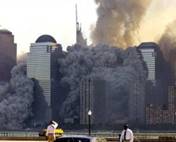
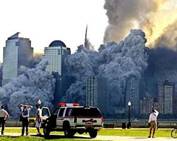
on earth for? It is worth showing some pictures here that show how parts of the North Tower took much longer than free-fall speeds to collapse:
The Debunking 911 site devotes a page to demonstrating that the buildings did not fall at free-fall speeds, and is worth looking at: www.debunking911.com/freefall.htm. 2.10 Controlled Demolition “Implosions” Require
Skill
The photos above show that Jones is exaggerating ‘straight-down and complete collapses’: Jones: “The occurrence of nearly symmetrical, straight-down and complete collapses of the WTC 7 and the Towers is particularly upsetting to the “official” theory that random fires plus damage caused all these collapses. Even with high-level cutting charges, achieving such results requires a great deal of pre-planning and expertise.” This image sequence should destroy the myth that the Towers collapsed symmetrically or straight-down:
In frame 2 of the video sequence we can see a large chunk of WTC 2 falling down to its left. In frame 3 a much larger part of the building, most likely the 30-story section above the impact zone, clearly rotating away from the building, reaching – I would estimate – something like one-third of the Tower height away from the Tower. In the video it is clearly visible rotating away from the building, fully conserving its angular momentum. One has to ask why Jones ignores clear evidence like this, going back to the claims he makes in the previous section that this large chunk turned to powder in mid air. From the video it is clear that this section of the building is rotating as a relatively intact unit until we can no longer see its further progress, due to the dust cloud. Jones is highlighting a common perception, that the “nearly symmetrical, straight-down and complete collapses of the WTC 7 and the Towers” is the strongest evidence for controlled demolition. The Twin Towers present a very different case to the WTC 7 building, and their collapse is the most indelibly printed on the public imagination. However, they are most easily dealt with. Their collapse is like no controlled demolition ever carried out in the world. This is because they collapsed in a top-down fashion. Jones inadvertently confirms this when he quotes Harris: “Generally speaking, blasters will explode the major support columns on the lower floors first and then a few upper stories,” and Mark Loizeaux, president of Controlled Demolition, Inc: “If I were to bring the towers down, I would put explosives in the basement to get the weight of the building to help collapse the structure.” But it is absolutely clear from the way that the twin towers collapsed that there was no collapse from the lower floors or basement of the building: collapse began at the impacted floors and proceeded top-down. Jones makes no acknowledgement of this fact, confusing the issue further by stating: “Just right – “explosives in the basement” agrees with eyewitness reports of pre-collapse explosions down low in the buildings (point 7 above). Also, this would be the way to effectively sever the support columns, consistent with both the apparent initial drop of the communication tower (WTC Tower 1) and the “kink” in the middle of WTC 7 as its collapse began.” This is patently absurd. Jones imagines that explosive detonations were carried out low in the Tower buildings, severing the support columns, which then somehow ‘slid’ through the building while the outer structure remained in place, but achieving the initial drop of the North Tower antenna. He imagines that severed columns in the base of the building would somehow cause a collapse at floors 80 to 90 with no movement of the building in between. Any examination of the videos of collapse in conventional demolition show that once the lower columns are severed, collapse begins at the bottom of the building. The fact is that the Twin Towers began their collapse at the levels where the planes impacted, and that the unique top-down collapse, never seen before in the entire history of the demolition of tall buildings, ensured that they fell (very) approximately within their footprint, rather than toppling. In fact the spread of debris was far greater than would be acceptable in any implosion, but then, no building of this height has ever been demolished by explosives (a building like this would be dismantled). If Jones requires a controlled demolition theory, then the explosives would have to have severed columns at the level of aeroplane impact, not at the ground level. The WTC 7 building is a different case, which does resemble controlled demolition, in some aspects only, in particular that it follows a conventional bottom-up collapse. But the CD theory never recognises the following facts: 1. No building ever suffered both impact damage and fire on the scale of WTC 7, allowing unimpeded air supply not possible to fires in the absence of structural damage 2. No building ever burned for 7 hours with
such a complete absence of fire-abatement effort, made impossible by
the severing of water mains, and the extraordinary demands on the city’s
fire department. The initial ‘kink’ that Jones refers to is consistent with a localised collapse in the front centre of the building, consistent with the structural damage to the front of the building and the huge supply of air available. 2.11 Steel Column Temperatures of 800°C Needed:
A Problem in the Argument of Bazant and Zhou
Jones: “Correct – the WTC Towers were designed to withstand forces caused by large commercial aircraft – we can agree on that. MIT’s Thomas Eagar also concurs “because the number of columns lost on the initial impact was not large and the loads were shifted to remaining columns in this highly redundant structure” (Eagar and Musso, 2001).” Jones is stating here a widely circulated opinion: that the Towers were designed to withstand the impact of a commercial plane. But the CD theorists consistently overlook two factors here. Firstly that the designers had in mind an aircraft coming in to land at New York airport, at speeds of around 180 mph (according to the FEMA report, page 1:17). But the aircraft hit the towers at an average of nearly three times that speed. Given that the impact damage hinges on the kinetic energy of the projectile, which rises with the square of speed, the planes hit the Twin Towers with nearly nine times the impact anticipated. (Note that the NIST report - on page 6 - contradicts this argument by stating that the Towers were designed for a 600 mph impact. I would be pleased to hear from anyone who can settle this discrepancy one way or the other.) Secondly, design is an art not a science: the Titanic was designed not to sink; the space shuttle was designed not to explode on takeoff, and designed not to break up on re-entry. Etc. Jones: “They do NOT explain how steel-column temperatures above 800oC were achieved near-simultaneously due to burning office materials. NIST notes that office materials in an area burn for about 15-20 minutes, then are consumed away (NIST, 2005, pp. 117, 179). This is evidently not long enough to raise steel column temperatures above 800oC as required in the Bazant & Zhou model, given the enormous heat sinks of the structures. And to have three buildings completely collapse due to this unlikely mechanism on the same day strains credulity.” Jones is presenting perhaps the core issue that requires explanation: the high temperatures in all three fires. What the CD theorists consistently attempt to promote however is that the fires in the three buildings were standard ‘office fires’ which should not have led to collapse. This is simply not the case. In the case of the Twin Towers the impact and presence of the planes ensures that the structural damage and ensuing fires were like nothing previously encountered. Some images are essential here to convey the magnitude of the situation.
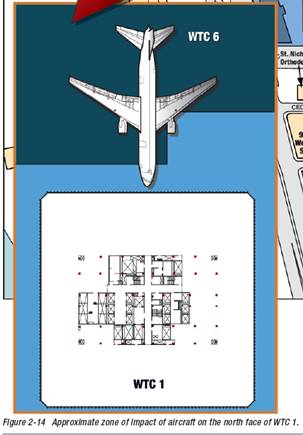
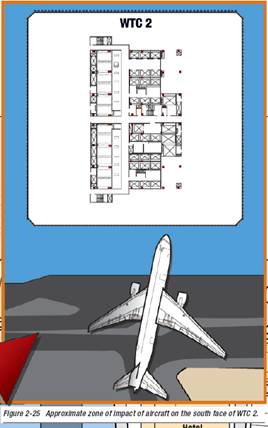
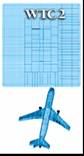
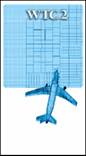
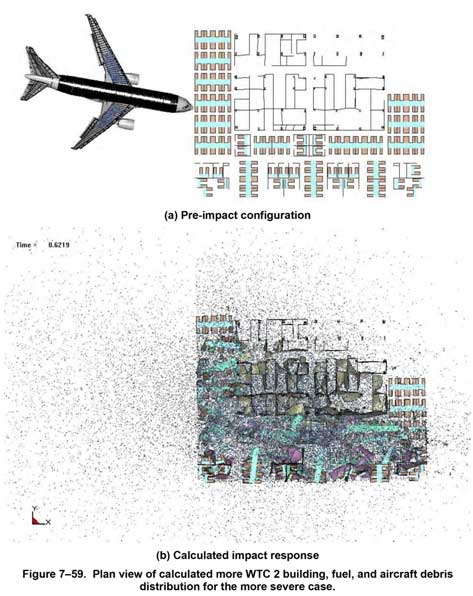
These diagrams require that any serious thinker on this subject consider the impact of the planes: AA flight 11 crashed into north face of North tower (WTC1), between floors 94 and 98, at 470 mph, and UA 175 crashes into south face of the South Tower (WCT2), between floors 78 and 84, at 590 mph. One CD theorist compared these impacts to a ‘pencil going through a mosquito net,’ part, it seems, of a consistent attempt to downplay their importance. Here is a visualisation of the impact on WTC2:
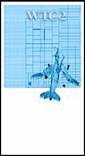
Fig. 3 Frames from a visualisation of WTC2 impact (source: www.geocities.com/debunking911) As the FEMA report points out, UA 175 crashed into the WCT2 in a direction to make its passage towards the central core of the building much shorter. Here is a visualisation of the impact damage:
Fig. 4 Visualisation
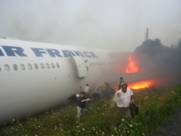
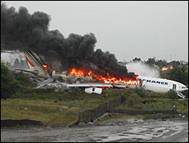
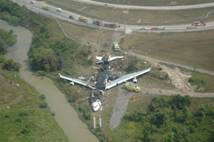
of impact damage on WCT 2 (source: www.geocities.com/debunking911) While no-one can verify the details of such a visualisation, it would be at the very least likely that a significant number of core columns would have been damaged by the impact alone, prior to any weakening by fire. A passenger jet can crash and initiate intense fires, even, apparently, without its aviation fuel igniting, as in this example of an Air France accident:
Fig. 5 Air France Airbus
340 flight 358 crash (source: www.geocities.com/debunking911,
see also http://en.wikipedia.org/wiki/Air_France_Flight_358) One can see that the wings of the aircraft, where the fuel is kept, did not catch fire. The intense blaze and utter devastation of the fuselage was due only to friction on impact and combustibles within the fuselage. Notice the intense yellow-orange base of the fire behind the wing in the first picture: easily hot enough to melt aluminium at 650 degrees centigrade. If one now imagines this crash compressed into the impact zones in the Towers, plus around 10,000 gallons each of aviation fuel, then how can one conceive of the resulting conflagration as a mere ‘office fire?’ Returning to the impact of the planes, one can calculate their kinetic energy at the time of impact to be about 4.415 x 1009 Joules (equivalent 4 million one bar electric fires operating for one second). This energy alone is capable of melting four metric tonnes of steel, though of course no one would suggest that the kinetic energy of a plane would be converted 100% into heat and focussed on the steel. The energy would appear as a mixture of fracture energy, sound energy, heat energy and even a small amount of light. But the point seems to be lost on the CD theorists: that impact energy was substantial, and that a significant proportion would be converted to heat energy, never mind the combustibles on the plane and the aviation fuel. To put it another way: how can one ignore 150 metric tonnes of aircraft impacting at speeds between 470 and 590 mph, when skidding off a runway at perhaps only 100 mph caused a complete conflagration in Air France 385? And when it received prompt attention from the airport fire brigade? (They were hampered by heavy rain which diluted the millions of gallons of foam deployed on the blaze, and it took 12 hours to put out.) This is another key issue that the CD theorists ignore: the lack of fire abatement provision that would be normal in a conventional ‘office fire.’ The 9/11 Commission Report details the decision made early in the events that the fire department response would be rescue only and not fire fighting (p. 290-291). This decision was made on the grounds of the magnitude of the emergency at that point, and the imperative to rescue thousands of office workers. Also clear is that the fire department had no idea whether any water supply was still functional. Summary In the 17-minute period between 8:46 and 9:03 A.M. on September 11, New York City and the Port Authority of New York and New Jersey had mobilized the largest rescue operation in the city's history. Well over a thousand first responders had been deployed, an evacuation had begun, and the critical decision that the fire could not be fought had been made. (CR p.293, my italics)
This is a good point to raise a pet theory of mine (and it is only a theory): that the many tons of aluminium in the planes may have contributed to the fire and the high temperatures, by igniting. Normally, aluminium does not burn in air, due to the very tough layer of oxide that rapidly forms on its surface. However the Air France jet would have involved abnormal conditions in which the aluminium was effectively ground against concrete at 100 mph, bearing the weight of the plane. The friction involved was enormous, and sufficient to bring the plane to rest, and may have provided, along with an 100 mph oxygen supply, the conditions for the aluminium to burn. The impact conditions of the planes entering the Twin Towers was likewise far from normal, and even if only a few tons of the aluminium burned, it would have produced very high temperatures indeed and a large heat input to the conflagration. It will be interesting to see, when the Air France crash report is produced, whether it shows (a) that indeed little or no aviation fuel contributed to the fire, and (b) whether the aluminium of the hull burned rather than just melted. 2.12 Problems in the NIST Report: Inadequate Steel Temperatures and Tweaked Models
Jones: “However, I along with others challenge NIST’s collapse theory. NIST maintains that all three building collapses were fire-initiated despite the observations above, particularly the fact that fire endurance tests with actual models did not result in collapse. … I agree with these pointed objections, particularly that the “response of the whole frame” of each building should be considered, especially heat transport to the whole frame from localized fires, and that the “core columns cannot pull the exterior columns in via the floor.” (Lane and Lamont, 2005)” From a scientific point of view these are some of the most difficult issues to deal with, but Jones misrepresents NIST here when he says “NIST maintains that all three building collapses were fire-initiated.” NIST is careful to point out that the collapse resulted from three factors, not the single factor of fire. The two additional factors, apart from fire were (1) structural damage due to impact, and (b) the damage to insulation caused by the impact. NIST say: “In the absence of structural and insulation damage, a conventional fire substantially similar to or less intense than the fires encountered on September 11, 2001, likely would not have led to the collapse of a WTC tower.” (NIST NCSTAR 1, p. 176) Jones may be right when he says that heat transport away from the fire zone may not have been considered, but the fact is that the conductivity of steel is not that good (as he points out himself elsewhere in his paper), and localised heating is very easy. One only has to look at a workman cutting through steel with an oxyacetylene torch to realise that heat transport away from the cutting area is poor. Jones “The computerized models of the Towers in the NIST study, which incorporate many features of the buildings and the fires on 9-11-01, are less than convincing. … The NIST report makes for interesting reading. The less severe cases based on empirical data were discarded because they did not result in building collapse. But ‘one must save the hypothesis,’ so more severe cases were tried and the simulations tweaked, as we read in the NIST report: …” Jones has an important point here, that computerised models, along with all the diagrams, sketches and visualisations presented in the official reports (and elsewhere), are open to challenge. But the term ‘tweaking’ is a rather leading one (though not as leading as the term ‘revisionist’ that Griffin uses). The point of adjusting the model’s parameters until the model shows collapse is to arrive at parameters consistent with the hypothesis. The parameters themselves are then open to scrutiny. As NIST says, quoted by Jones: “To the extent that the simulations deviated from the photographic evidence or eyewitness reports [e.g., complete collapse occurred], the investigators adjusted the input, but only within the range of physical reality. Thus, for instance,…the pulling forces on the perimeter columns by the sagging floors were adjusted... ” NIST is saying that the parameters are “within the range of physical reality,” so it is up to Jones to demonstrate that they are not, in which case the NIST hypothesis would look weak. But instead Jones mocks the modelling process itself by saying “How fun (perhaps) to tweak the model like that, until the building collapses -- until one gets the desired result.” This misrepresents the purpose of the modelling, which in reality is to arrive at parameters then open to scrutiny. But Jones merely puts forward some opinion regarding other fire models which failed to predict collapse, without any mention of whether those models included the two additional factors that are core to the NIST hypothesis: structural damage, and insulation damage. Jones: “So how does the NIST team justify the WTC collapses, when actual models fail to collapse and there are zero examples of fire-caused high-rise collapses? Easy, NIST concocted computer-generated hypotheticals for very “severe” cases, called cases B and D (NIST, 2005, pp. 124-138). Of course, the details are rather hidden to us. And they omit consideration of the complete, rapid and symmetrical nature of the collapses.” Jones persists here in ignoring what NIST are saying: that their models do predict collapse for a certain range of parameters (within the range of physical reality), and that the collapse was not due to fire alone, but due to fire + structural damage + insulation damage. It is true that NIST chose not to consider the dynamics of the structures once collapse was initiated, but they had no particular reason to do so. Jones concludes this section by saying: “What about the subsequent complete, rapid and symmetrical collapse of the buildings? What about the observed squibs? What about the antenna dropping first in the North Tower? What about the molten metal observed in the basement areas in large pools in both Towers and WTC 7 as well? Never mind all that: NIST did not discuss at all any data after the buildings were “poised for collapse.” Well, some of us want to look at ALL the data, without "black-box" computer simulations that are “adjusted,” perhaps to make them fit the desired outcome. An hypothesis which is non-refutable is non-scientific. On the other hand, Occam's razor suggests that the simplest explanation which addresses and satisfies ALL the evidence is most probably correct.” In this paper we meet all of Jones’s objections made here. If Jones wants to really put forward a hypothesis that satisfies all the evidence, then that hypothesis (controlled demolition) needs to be spelled out in some detail to see if it can withstand the kind of scrutiny that the impact / fire hypothesis has been exposed to. 2.13 NIST's Failure
to Show Visualizations
Jones may have a valid criticism here, but equally he may not. To ‘show’ visualisations is precisely what NIST have done in their report, by including numerous diagrams generated by the modelling software. Perhaps Jones would like access to the software itself plus the final database and its variants, in order to better understand the model. But I don’t know how common it is to make copies of proprietary software and datasets available on request. Certainly it is difficult, without substantial resources, to obtain such software, and to construct the datasets necessary for such visualisations. But the onus is on Jones, if he wants to show the validity of the CD theory, to attempt at least a basic model of the proposed demolition sequence, and to test it on available software. 2.14 Jones’s Summary
Jones concludes his case with this summary: Jones: “Remarkably, the controlled demolition hypothesis accounts for all the available data rather easily. The core columns on lower floors are cut using explosives/incendiaries, near-simultaneously, along with cutting charges detonated up higher so that gravity acting on now-unsupported floors helps bring down the buildings quickly. The collapses are thus near-symmetrical, rapid and complete, with accompanying squibs -- really very standard stuff for demolition experts. Thermate (whose end product is molten iron) used on some of the steel columns readily accounts for the molten metal which then pooled beneath the rubble piles as well as the sulfidation observed in steel from both the WTC 7 and Towers rubble piles (points 1 and 2 above). I believe this is a straightforward hypothesis, much more probable actually than the official hypothesis. It deserves scientific scrutiny, beyond that which I have been able to outline in this treatise.” I have shown that the controlled demolition hypothesis does not account for the available data at all, and that this summary by Jones is absurd. If the core columns on lower floors had been cut, then the building would have been observed to have collapsed starting from that point, pancaking into the lower floors. It did not. If the speed of descent required cutting charges detonated higher up, then other buildings falling at the same speed would do so because of such charges. They do not. If the observed ‘squibs’ were due to controlled demolition, they would have just appeared prior to collapse, and would not involved prolonged expulsion of material. They did not. Thermate is just not ‘standard stuff’ for demolition experts: they never use it because its timings are uncontrollable, and its combustion products cannot cut steel columns. It is simply bad science for Jones to say: ‘The core columns on lower floors are cut using explosives/incendiaries, near-simultaneously’ (my italics) because the slow action of an incendiary like thermite makes any attempt at precise timings impossible. Molten metal beneath the rubble may have a number of causes, the most likely of which is the mgh energy of the building. If only 0.1 % of its collapse energy (one thousandth) were converted to heat, then that would be sufficient to melt a metric tonne of steel. In another of Jones’s concluding remarks he says: “The controlled-demolition hypothesis cannot be dismissed as "junk science" because it better satisfies tests of repeatability and parsimony. It ought to be seriously (scientifically) investigated and debated.” [my italics] It is precisely because the events of 9/11 are not repeatable that makes the science around
its investigation difficult. In real scientific terms the different
hypotheses would have to be tested by flying similar aircraft into similar
buildings: clearly impossible. But Jones’s appeal to ‘parsimony’ is
instructive: it seems that he would like a simple explanation of the
events instead of the complex impact-plus-fire-plus-insulation-damage
‘official’ hypothesis. We show here that controlled demolition is far
from the parsimonious account that he believes, because when examined
seriously it generates far more problems than it solves. 3 Additional Arguments for the CD Hypothesis
Jones in his online paper does not rehearse all the arguments put forward by CD theorists, so for completeness I list and address them here. 1. Timing of Tower collapses in reverse order of impact 2. Energy required to pulverise concrete and produce dust clouds greater than potential energy of buildings 3. Seismic recordings made by Columbia University consistent with controlled detonations 4. Sudden onset of collapse consistent with demolition 5. Core columns should have remained standing 6. Explosions in the sub-basement There are of course many more, but some cut-off is required, as even the CD theorists point out. They call the more outlandish suggestions, e.g. that the Towers were brought down by missiles, a ‘poisoning of the well,’ perhaps suggesting even that there is a conspiracy to discredit the CD theory with totally implausible ideas. We are attempting to show however that even any sober variant of the CD theory faces difficulties far greater than the IF theory. 3.1 Timing
of Tower collapses
Griffin cites a theory by Meyer that suggests that the fire in the South Tower had less fuel than in the North Tower and therefore went out earlier, despite having been initiated later. Those controlling the demolition (in this imagined scenario) were then forced to detonate their cutter-explosives at that point to bring the building down, and then waited until the fire in the North Tower went out until they brought that down. (NPH, p.18) But Griffin fails to put forward the NIST hypothesis, stated in Finding 58 (NIST NCSTAR 1-6, p.338): “The time it took for each WTC tower to collapse was due primarily to the difference in structural damage, the time it took the fires to travel from the impact area across the floors and core to critical locations, and the time it took to weaken the core and exterior columns. WTC 2 had asymmetric structural damage to the core, including the severing of a corner core column, and WTC 1 had more symmetrical damage. The fires in WTC 2 reached the east side of the building more quickly, within 10 min to 20 min, than the 50 to 60 min it took the fires in WTC 1 to reach the south side.” It is worth clarifying this a little: the difference in structural damage, and hence the subsequent sequence of events, was due to two factors: the much faster speed of the plane that hit WTC 2 compared to the plane that hit WTC 1, and the orientation of the plane to WTC 2, which meant that it (a) created a more asymmetrical impact zone, as confirmed in the tilting of the entire structure above, and (b) had a much shorter distance to travel in order to impact on the core structure of the building. We note also that Mark Loizeaux had instinctively predicted that WTC 2 would collapse earlier, because it was hit lower down. His implication, clearly, is that the extra weight on the impact zone would cause structural supports to give way more quickly. 3.2 Energy Required to Pulverise Concrete
The CD theorists are drawing on two factors in arguing that the pulverisation of the concrete in the Towers could not have been the product of gravitational collapse. The first argument is intuitive: it just seems improbable, judging from the photos and videos of the early stage of collapse, especially before the collapse has reached any speed. The second factor is a calculation made by Jim Hoffman, and widely cited. Before looking more closely at the calculations, I can point out again that it is a knowledge of demolition that provides the evidence here against the CD theory. Quite simply, in controlled demolition, the proportion of pulverisation accounted for by the explosives is negligible. To state again the first principle of explosive demolition: explosives initiate the collapse, gravity does the rest. In Hoffman’s calculations on the energy required to produce the dust cloud he starts with an estimate of the dust cloud volumes from this photograph:
He proceeds to make estimates of the volume of this cloud, and the expansion of it as an entity, starting from the volume of the towers. Along the way, he has to make numerous other estimates, including the average particle size of the cloud and so on. He claims at each stage to make a conservative estimate, and concludes his calculations thus: ‘The
amount of energy required to expand the North Tower's dust cloud was
many times the entire potential energy of the tower's elevated mass
due to gravity. The over 10-fold disparity between the most conservative
estimate and the gravitational energy is not easily dismissed as reflecting
uncertainties in quantitative assessments.’ This assessment that the dust cloud alone required ten times the North Tower’s gravitational energy (mgh energy) to produce is widely cited by the CD theorists, including Griffin, and is of course startling. But they do not point out that the mgh energy of the North Tower is alone equivalent to about 270 tonnes of high-explosive TNT, and for both towers together 540 tonnes. If Hoffman’s calculations are to be taken seriously, this requires a total of 5,400 tonnes of TNT or equivalent explosives, less the 540 mgh equivalent. Hoffman’s calculations would therefore require nearly 5,000 tonnes of high explosive to be packed into the two towers (5 kilotonnes of TNT equivalent). By way of comparison, the nuclear bomb dropped on Hiroshima is estimated at between 12 and 14 kilotonnes of TNT equivalent. Can Hoffman be serious? As of August 2006, even Hoffman doesn’t seem to be serious, as he has now reached version four of his analysis, which is supposed to replace his previous versions, but which he chooses not to place on the internet (version four is at: http://911research.wtc7.net/papers/dustvolume/volumev4.html and has withdrawn all his estimates and calculations). There is no indication that his research has been submitted for publication and hence peer review by scientists competent to assess his estimates and calculations. All we can do at this stage is point out that his claim of the ten-fold disparity in energy requirements, as a conservative disparity, would require the conspirators to hide of the order of five thousand tonnes of TNT equivalent in the Twin Towers, an equivalent of more than a third of the Hiroshima bomb. It is more likely however that his train of assumptions is faulty, perhaps even his starting point in attempting to model the immense complexity of the dust cloud as the expansion of a discrete volume of gas. As to the energy required to pulverise the rubble,
the calculations are uniquely dependent on two estimates: the average
size of the particles, and the strength of the material. The CD theorists
rely on only the most general of guesses as to the first figure, and
insist on using only the strength of concrete
in their calculations. Given that a significant proportion of the dust
would have been generated from plaster,
with a much lower strength, their estimates must be regarded as unreliable.
Technically, the production of rubble or powder from rock or aggregate
is known as comminution, and
the energy required depends on what is known as the Bond work index:
this is highest for rock, less for concrete, and much smaller for plaster. 3.3 Seismic Recordings
Many CD theorists draw attention to seismic recordings as evidence of the CD theory. Griffin (for example), drawing on Hufschmid, cites seismic data from Columbia University to support the CD theory: ‘In each case, “the shocks increased during the first 5 seconds then dropped abruptly to a lower level for about 3 seconds, and then slowly tapered off.” This pattern, Hufschmid suggests, reflects the fact that the first explosives detonated were those near the tops of the towers, where the steel columns were the thinnest. The shocks get stronger as the detonation pattern, controlled by a computer programme worked its way down.’ (Griffin TNPH, p.19) This is easily shown to be fallacious. Firstly, as the one of Columbia authors confirmed in a later email, their seismic data “are far too weak in signal-to-noise ratio and far too speculative in terms of signal source to be used as a means of contradicting the impact times …” (Commission, p.462) But the key mistake however, is the idea that any building is demolished by a progressive wave of explosions either working its way up or down a building. Popular Mechanics gives a good account of why the seismic
spikes do not support the CD theory: www.popularmechanics.com/science/defense/1227842.html?page=5&c=y.
This evidence makes a compelling argument against explosive demolition. The laws of physics dictate that any detonation powerful enough to defeat steel columns would have transferred excess energy through those same columns into the ground, and would certainly have been detected by at least one of the monitors that were sensitive enough to record the structural collapses. However, a detailed analysis of all available data reveals no presence of any unusual or abnormal vibration events. 3.4 Sudden Onset of Collapse ‘Consistent with
Demolition’
This is one of the central myths of the CD theory. NIST show clear photographic evidence of the bowing of the exterior walls and collapse of interior floors in both Towers, with timings showing an acceleration of this bowing prior to the initiation of collapse. There was no sudden onset of collapse consistent with demolition. On the contrary the CD theory is unable to explain the bowing and other structural deformations prior to collapse. Eyewitness accounts from firemen also confirm a huge bulge in the south elevation of WTC 7 prior to collapse, the phenomenon more than any other that persuaded fire chiefs to withdraw their forces from danger. 3.5 Core Columns ‘Should Have Remained Standing’
Many CD theorists make the assertion that the ‘core columns should have remained standing’ during the collapse of the Towers, presenting the metaphor of records (as floors) sliding down the central spindle (as the building core). But they do not consider the NIST explanation which points out that the core columns were designed only to withstand compressive loads, whereas the outer columns were the ones designed to withstand all lateral loadings (principally winds up to hurricane speed). As each floor collapsed it would have created lateral forces on the core columns which were sufficient to either tear away the bolts or sever the columns themselves as they ‘peeled’ away from the centre. If the CD theorists insist that explosives were used to sever the core columns, then this commits them to a variant of the CD theory requiring explosives on every single floor, multiplying the tonnage of explosive required by a factor of around 100. It also commits them to a sequential detonation, which would travel down in the Towers and up in WTC 7, requiring technologies well beyond anything seen in industrial practice. 3.6 Explosions
in the Sub-Basement
In an afterword in Jones’s paper he reports an eye-witness statement from William Rodriguez: “My basis was, like I told the Commission, there was an explosion that came from under our feet, we were pushed upwards lightly by the effect, I was on basement level 1 and it sounded that it came from B2 and B3 level. Rapidly after that we heard the impact far away at the top.” Jones takes this as evidence for the CD theory, firstly that explosions were heard or experienced at the ground or basement level, and secondly that subsequent sounds were heard, assumed to be the impact of the planes. The IF theory as elaborated by NIST accounts only for the ‘explosions’ at ground and basement levels: these were due to the fuel-air mix forced down shafts that had been opened up at the impact levels by the destructive impact of the planes. NIST report that not only a fuel-air mix was propelled down the shafts in the core of the building, but the force of these was sufficient to smash lift cages to the ground. People were killed and injured in these events, and windows were blown at the concourse level. 4 David Ray Griffin and the Dustin Mugford DVDA DVD produced and directed by Dustin Mugford is distributed by 911revisited.com and is called ‘September 11 Revisited: Were Explosives Used to Bring down the Buildings?’ I regard the DVD as a good example of the kind of one-sided propaganda that pressure groups use to convey their beliefs. It is propaganda because it deploys the classical rhetorical techniques of loaded terminology and repetition of its message, and it is one-sided because it pretends, as do all the counter-orthodoxies, that there is only the official version and the counter-orthodoxy. They do not mention the groups I have referred to above, which, independently of any official or Federal account, set out to disprove the counter-orthodoxies, offering evidence that would make the arguments balanced. The film opens with the repeated use of the word ‘explosive’ in such a way as to reinforce, in advance, the thesis put forward, that explosives brought down the WTC buildings. A range of eye-witnesses use the term in their accounts, but we have argued above (section 2.7) that no eye-witness has been played audio tapes of the signature ‘crack’ of demolition explosives and asked to estimate their similarity or otherwise to the reports they recall hearing on the day. Characteristic of the appeal of the entire counter-orthodoxy is the single phrase uttered by a reporter in one of the clips looking on as the destruction unfolded: ‘This defies belief’ (13:54 into the video). This is a natural response for the lay person, but the trained scientist should not then reach for the apparently easy explanation for it all: explosives. At 18:53 into the video a reporter reminds us that Jones is putting his ideas forward as a hypothesis only, not as fact, and is calling for a fresh investigation to establish the truth. But David Ray Griffin, speaking next on the video, says: ‘The collapses of the Twin Towers and building number 7 had to have been examples of controlled demolition, brought about by thousands of explosives, placed throughout each of the buildings.’ Griffin, not a trained scientist, but a philosopher and theologian, has made the unforgivable error in science: to jump from a statement of hypothesis to a statement of fact. He is speaking from a podium marked ‘University of Wisconsin, Madison’ and delivers these lines with gravity and simplicity. A lay audience is inevitably impressed by his status as an academic, and the setting of the talk. They were given no chance to contemplate the possibility that the ‘thousands of explosives’ were merely a theory, based, as I have shown, on a complete misunderstanding of the science and practice of industrial explosive demolition. But Griffin, not prepared to wait for the further scientific investigation that Jones is calling for, has already made his mind up. He continues: ‘No foreign terrorist could have obtained the kind of access to the buildings this would have required.’ Griffin, untrained in science, and seemingly completely unaware of the actual nature of explosive demolition states the CD mantra: ‘The buildings collapsed straight down and at virtually freefall speed, as in controlled demolitions.’ We have seen that WTC2 certainly did not collapse ‘straight down’, and that the ‘virtually’ freefall speeds in controlled demolitions, are nothing to do with explosives, but are purely gravity powered. Untrained in science, but well-versed in public speaking, Griffin smiles at the audience and says: ‘Try this: take a piece of concrete, and drop it a little over a thousand feet, and see if it pulverises into very fine dust. It won’t happen.’ But we have shown that the pulverisation of concrete in conventional explosive demolition has, again, nothing to do with explosives. It is gravity that reduces the buildings in controlled demolition to rubble and dust: the thousands of tons above the piece of concrete, acting something like a hydraulic press, are what smashes it. The mgh energy in each of the Towers, to repeat the point, was equivalent to 270 tons of TNT: no additional explosives were needed. Griffin also suggests that the very high temperatures in the basement rubble of the Towers ‘points to the existence of very powerful, precisely placed explosives.’ But explosives are incapable of heating up any significant quantity of metal, because their energies are dissipated in fractions of a second as shock waves. Their use in controlled demolition is to cut, not to pulverise or to heat or melt. Griffin goes on to ridicule the official ‘pancake’ theory. He says, with a grin inviting the audience to share in the joke: ‘Now, even if this theory were remotely plausible, can you imagine it pancaking at freefall speed?’ Note that Griffin has moved on from ‘virtually’ freefall speed to straight freefall speed: bad science. As I have shown however, whatever the difficulty in imagining pancaking taking place at these high speeds, it is the practice of controlled demolition that proves Griffin completely wrong again. The speed of pancaking in conventional explosive demolition has nothing to do with the use of explosives: it purely gravity powered. The Griffin section of the video concludes with the issue of the core columns and the idea that they should have remained standing even if the floors did pancake according to the official theory. He uses the analogy of records stacked up above a turntable moving down, but leaving the spindle intact. But, instead of considering the physics of a vertical column, designed for compressive not lateral loading, pulled away from the vertical by the collapsing floor members, and asking whether the estimated shear loads were sufficient to fracture them or to break the joints, Griffin resorts to another popular 9/11 myth: that the 9/11 Commission Report deny the very existence of the core columns. He says: ‘It avoided the problem, incredibly, by simply denying the existence of these columns. … This supposedly authoritative report said that the interior core of the buildings was a hollow steel shaft in which elevators and stairwells were grouped. Such a desperate lie is a sure sign of a cover-up.’ It would indeed be a ‘desperate lie’ if the final report actually denied the existence of the core columns. It is true, in fact, that the Commission Report includes this statement: ‘…These exterior walls bore most of the weight of the building. The interior core of the buildings was a hollow steel shaft, in which elevators and stairwells were grouped.’ But this statement is tucked away at the end of the document (on page 541 of 567) as part of a footnote to page 278. The purpose of the footnote was generally to direct the reader to the FEMA report which contained more details on the building. But the Commission Report never set out to give an account of the collapse of the buildings, as that task was completed in broad terms in the FEMA report, and in much more detail in the NIST report, both of which deal extensively with the core columns. The NIST report has this to say on the question of loading between the exterior columns and the core columns: The dense array of columns along the building perimeter was to resist the lateral load due to hurricane-force winds, while also sharing the gravity loads about equally with the core columns. [NCSTAR 1, p.6] So, how much of a desperate lie are the offending few lines tucked away in a footnote at the end of the Commission Report? It is clearly not accurate, as the gravity loads are shared equally across the two types of column (though the exterior columns bore all of the lateral weightings). But to the lay audience at Madison University Griffin’s account would suggest that the official reports as a whole had conspired to deny the importance of the core columns, or even their existence. Anyone who has read the FEMA and NIST reports with their focus on technical issues, and who can see from the Commission Report that it did not set out in any of its chapters to give an account of the mechanics of collapse, must conclude that it is Griffin who is perpetuating a lie. What then of Griffin’s two books on the subject: The New Pearl Harbour (TNPH), and The 9/11 Commission Report (TNCR)? In both books Griffin repeats what I believe to be the bad science put forward by Jones and others, with no attempt to balance their claims with those by other technical experts, official or otherwise. And, as the TNCR title suggests, he repeats in it his absurd claim that the official reports omit the core columns (p.27). Here is an extract: With
regard to the more basic question – Why did the Twin Towers collapse
at all? – the Commission implies an answer by saying that the outside
of each tower was covered by a frame of 14-inch-wide steel columns.
… These exterior walls bore most of the weight of the building. The
interior core of the buildings was a hollow steel shaft, in which elevators
and stairwells were grouped. (541n1) This
implicit explanation, however, involves a complete falsification, because
the core of each tower was composed not of a “hollow steel shaft” but
of 47 massive steel columns, … Griffin concludes the section by saying ‘The Commission avoids this embarrassing problem by simply denying the existence of those massive steel columns – therefore either demonstrating enormous ignorance or telling an enormous lie.’ Enormous lie? A paragraph buried in the footnotes at the end of the document which, true, is inaccurate, but by no stretch of the imagination can be an answer to the question: Why did the Twin Towers collapse at all? Why on earth should anyone believe that this document chooses to answer a very complex technical question by a remark buried in the footnotes, the purpose of which footnote is to refer the reader to the FEMA report? Why should anyone believe that the Commission are guilty of ‘either enormous ignorance or telling an enormous lie’ in connection with the Twin Towers collapse when the technicalities of this event are thoroughly dealt with in the FEMA and NIST reports, both of which deal extensively with the core columns? I regret to say that I have found both of Griffin’s books to be on a par with the Dustin Mugford DVD: that is they are one-sided propaganda. It would take a book-length refutation to fully answer Griffin, but I believe that the discussion here shows him to be an unreliable thinker on such complex issues. I think it instructive however to ask the question why his methods of argument seem so persuasive to many. His approach seems to be to multiply accusations, without giving each point a careful and balanced discussion. A friend of mine suggests that this approach in argument is like a rope made from many threads: each thread on its own may be weak, but the rope as a whole is strong. Appealing as this image is, I cannot shake off the suspicion that, in argument, as opposed to making ropes, this method is alarmingly like mud-slinging. I will give an example: Griffin states early on in TNCR that ‘One problem is that at least six of the nineteen men officially identified as the suicide hijackers reportedly showed up alive after 9/11’ (p.19) This is naturally intriguing, so I Googled the first name he cites: Waleed M. al-Shehri, and the first site I encountered was the Wikipedia entry for the hijacker. Wikipedia has this to say: Waleed and Wail were both mistakenly reported to have been found alive and well, by the BBC later in 2001. They were initially reported in error by a Saudi newspaper editor as the sons of Ahmed Alshehri, a senior Saudi diplomat stationed in Bombay, India. On September 16, 2001, the diplomat Ahmed Alshehri denied that he was the father of the two hijackers. Wail claims he did attend Embry-Riddle Aeronautical University in Daytona Beach, Florida - but was the victim of mistaken identity, since he used that training to secure his current position with a Moroccan airline company. Saudi Arabia has confirmed his story, and suggested he was the victim of identity theft. Why doesn’t Griffin mention the opinion of Wikipedia and the Saudi government, and allow the reader to decide? The muddle over the transliteration of Arabic names is endemic in the relationship between the US and the Islamic world, and is part of the wider cultural gap that allows for such misunderstandings to proliferate. Griffin goes on to say: How can we believe that the Commission’s report was based on “exacting investigative work,” as we are told by Kean and Hamilton in the Preface, if the staff did not even learn, from sources such as the Associated Press, the Telegraph, and the BBC, that six of the men originally identified as hijackers were still alive?’ [TNCR p. 20]. But I would reply to Griffin: how can we believe your books when you don’t check up on anything, whether it is the science of demolition, or erroneous reports by the BBC? It seems to me that Griffin is content to pick up on any accusation germane to his thesis, and bind it into his ‘rope’ without giving the reader any suggestion that evidence exists to the contrary. By moving breathlessly from one such accusation to another, he draws the reader along to his grand conclusion: to me it seems more like mud-slinging than a coherent argument. He also seems to revel in calling any official who changes their mind on any of the events of 9/11 ‘revisionists.’ This is an extraordinary word to use, deriving I believe from the Communist era, and intended to discredit through the emotional charge that the word carries. But good science is always open to revision, and the fact that an investigator changes their mind as new evidence emerges is a positive sign, not immediate proof of conspiracy. 5 Conclusions
Good science involves the slow development of theories based on careful checking and re-checking of data. Hence I am surprised that Professor Jones, trained in science, should be so hasty in his presentation, including the apparent unwillingness to properly investigate the science and practice of explosive demolition, and the even graver errors such as assertions that a large section of the Twin Towers was reduced to dust in mid-air, when video footage clearly shows the section he refers to falling as a whole (and fully conserving angular momentum.) I am not surprised however that David Ray Griffin, as a theologian and philosopher, should be utterly cavalier about scientific evidence in particular and other evidence in general. My studies of the Enlightenment philosophers showed that they collectively may have been inspired by the emerging discipline of physics, but completely failed to grasp its workings and real significance, and resented its emerging cultural prominence. From Hume onwards, philosophers have sought to reclaim what they had regarded as their birthright: the cultural status of philosophy as the ‘queen of sciences.’ Rorty represents the ultimate postmodern rejection of good science: Griffin merely ordinarily ignorant of it. I leave the author of the Debunking 911 site the last word, sentiments I wholeheartedly agree with: This is the kind of thing the "scholars" want us to pay millions more investigating. Personally, I could think of a few other pressing issues to spend millions on. Like research into the collapse of critical thinking skills in American and UK universities. [See www.debunking911.com/overp.htm, bottom of page.] |