Richard Jefferies seems to have been something of a lone voice in mid-19th century Britain when it comes to the particular view of Nature that we are investigating here. The Romantic writers, in particular Wordsworth, come closest in spirit, but Nature tends to be the fuel of imagination rather than transcendence in their work. In contrast, mid-19th century America produced a number of writers who were either Nature mystics or in whose Nature writings we can often find a thread of transcendence. Although the term is used in a different way, America was of course the home of the new literary and philosophical movement, the Transcendentalists, founded by Ralph Waldo Emerson. He visited the British Romantics, Wordsworth and Coleridge, but took his philosophy in a different, very American, direction, partly based on Kant. More important to us is his friend Henry David Thoreau, whose Nature writings have a surprisingly strong resonance with Jefferies, though they were unknown to each other. At the same time the two great American naturalists of the 19th century, John Muir and John Burroughs, were articulating a new consciousness regarding the great wildernesses of America, the first concerns that man's dominion over the natural world could not go unchecked for ever. These two men were friends and are credited with creating the beginnings of the ecology movement; Burroughs is also important for us because he was friend and biographer of Whitman.
Emerson will not be included in this section because, although his writings on Nature can rank with the best to be found from the time, his intelligence was more subtle and convoluted than makes a good Nature mystic—he has the beginning of a 20th century diffidence. Here is just a short quote from his essay on Nature that is in keeping with the Nature mystics:
It seems as if the day was not wholly profane, in which we have given heed to some natural object. The fall of snowflakes in a still air, preserving to each crystal its perfect form; the blowing of sleet over a wide sheet of water, and over plains, the waving rye-field, the mimic waving of acres of houstonia, whose innumerable florets whiten and ripple before the eye; the reflections of trees and flowers in glassy lakes; the musical steaming odorous south wind, which converts all trees to windharps; the crackling and spurting of hemlock in the flames; or of pine logs, which yield glory to the walls and faces in the sittingroom, -- these are the music and pictures of the most ancient religion.
We will return to the theme of Nature as the 'most ancient religion' in the next section (Scholars / Occult). Here we include another short section from the same Emerson essay that finds him now unsatisfied:
Quite analogous to the deceits in life, there is, as might be expected, a similar effect on the eye from the face of external nature. There is in woods and waters a certain enticement and flattery, together with a failure to yield a present satisfaction. This disappointment is felt in every landscape. I have seen the softness and beauty of the summer-clouds floating feathery overhead, enjoying, as it seemed, their height and privilege of motion, whilst yet they appeared not so much the drapery of this place and hour, as forelooking to some pavilions and gardens of festivity beyond. It is an odd jealousy: but the poet finds himself not near enough to his object. The pine-tree, the river, the bank of flowers before him, does not seem to be nature. Nature is still elsewhere. This or this is but outskirt and far-off reflection and echo of the triumph that has passed by, and is now at its glancing splendor and heyday, perchance in the neighboring fields, or, if you stand in the field, then in the adjacent woods. The present object shall give you this sense of stillness that follows a pageant which has just gone by. What splendid distance, what recesses of ineffable pomp and loveliness in the sunset! But who can go where they are, or lay his hand or plant his foot thereon? Off they fall from the round world forever and ever. It is the same among the men and women, as among the silent trees; always a referred existence, an absence, never a presence and satisfaction. ('Nature', from Essays: Second Series, 1844)
That Emerson finds a 'referred existence' in Nature, even a disappointment, almost brings him to the mood of the 20th century existentialists, but more on this later.
For now, if we put together the voices of Whitman, Thoreau, Muir and Burroughs, we have a powerful call for the values of Nature Mysticism, but ironically it is the lone voice of Jefferies on the other side of the Atlantic that articulates them most clearly. We have already looked at Whitman, now let us find in Muir, Thoreau and Burroughs the voices that echo Jefferies.
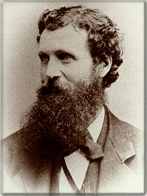 photo:
John Muir Memorial Association
photo:
John Muir Memorial Association
John Muir, born in Scotland, has been described as follows: 'A pre-eminent scholar, botanist, geologist, and writer, John Muir worked toward the preservation of the wilderness and is acknowledged to be the "Father of the National [US] Park System." His tireless efforts, writings, and friendships with presidents, writers, and philosophers influenced the nation's awareness of the need to preserve the wilderness for generations to follow.'
The following extracts from his letters, written while he was travelling or working in the high Sierra mountains, give some indication of Muir's sensitivity to Nature, bordering on the mystical. Muir, like other intelligent men of his time, had begun to question his Christian upbringing, in particular the doctrine of original sin, as this letter shows:
Your last, written in the delicious quiet of a Sabbath in the country, has been received and read a good many times. I was interested with the description you draw of your sermon. You speak of such services like one who appreciated and relished them. But although the page of Nature is so replete with divine truth, it is silent concerning the fall of man and the wonders of Redeeming Love. Might she not have been made to speak as clearly and eloquently of these things as she now does of the character and attributes of God? It may be a bad symptom, but I will confess that I take more intense delight from reading the power and goodness of God from "the things which are made" than from the Bible. The two books, however, harmonize beautifully, and contain enough of divine truth for the study of all eternity. It is so much easier for us to employ our faculties upon these beautiful tangible forms than to exercise a simple, humble living faith such as you so well describe as enabling us to reach out joyfully into the future to expect what is promised as a thing of to-morrow. (Letters, 1866)
We note that Muir is rather implying that the Christian ideal is future-oriented, whereas he finds his confirmation of God in the present 'tangible forms.' The next extract simply conveys Muir's love of the beauty of Nature:
I left Indianapolis last Monday and have reached this point by a long, weary, roundabout walk. I walked from Louisville a distance of 170 miles, and my feet are sore, but I am paid for all my toil a thousand times over. The sun has been among the treetops for more than an hour, and the dew is nearly all taken back, and the shade in these hill basins is creeping away into the unbroken strongholds of the grand old forests.
I have enjoyed the trees and scenery of Kentucky exceedingly. How shall I ever tell of the miles and miles of beauty that have been flowing into me in such measure? These lofty curving ranks of bobbing, swelling hills, these concealed valleys of fathomless verdure, and these lordly trees with the nursing sunlight glancing in their leaves upon the outlines of the magnificent masses of shade embosomed among their wide branches,--these are cut into my memory to go with me forever. (Letters, 1867)
The following passage is simply another lyrical but closely-observed description of what he sees:
The scenery, too, and all of Nature in the pass is fairly enchanting, strange and beautiful mountain ferns, low in the dark cañons and high upon the rocky, sunlit peaks, banks of blooming shrubs, and sprinklings and gatherings of [ ] flowers, precious and pure as ever enjoyed the sweets of a mountain home. And oh, what streams are there! beaming, glancing, each with music of its own, singing as they go in the shadow and light, onward upon their lovely changing pathways to the sea; and hills rise over hills, and mountains over mountains, heaving, waving, swelling, in most glorious, overpowering, unreadable majesty; and when at last, stricken with faint like a crushed insect, you hope to escape from all the terrible grandeur of these mountain powers, other fountains, other oceans break forth before you, for there, in clear view, over heaps and rows of foot hills is laid a grand, smooth outspread plain, watered by a river, and another range of peaky snow-capped mountains a hundred miles in the distance. That plain is the valley of the San Joaquin, and those mountains are the great Sierra Nevadas. The valley of the San Joaquin is the floweriest piece of world I ever walked, one vast level, even flower-bed, a sheet of flowers, a smooth sea ruffled a little by the tree fringing of the river and here and there of smaller cross streams from the mountains. Florida is indeed a land of flowers, but for every flower creature that dwells in its most delightsome places more than a hundred are living here. Here, here is Florida. Here they are not sprinkled apart with grass between, as in our prairies, but grasses are sprinkled in the flowers; not, as in Cuba, flowers piled upon flowers heaped and gathered into deep, glowing masses, but side by side, flower to flower, petal to petal, touching but not entwined, branches weaving past and past each other, but free and separate, one smooth garment, mosses next the ground, grasses above, petaled flowers between. (Letters 1868)
Muir is quite aware however that most people simply do not see Nature as he does, a sentiment we find in Jefferies, Whitman and Thoreau, but he is not too disturbed:
All sorts of human stuff is being poured into our valley this year, and the blank, fleshly apathy with which most of it comes in contact with the rock and water spirits of the place is most amazing. I do not wonder that the thought of such people being here, Mrs. Carr, makes you "mad," but after all, Mrs. Carr, they are about harmless. They climb sprawlingly to their saddles like overgrown frogs pulling themselves up a stream-bank through the bent sedges, ride up the valley with about as much emotion as the horses they ride upon, and comfortable when they have "done it all," and long for the safety and flatness of their proper homes. (Letters, 1870)
Muir of course spends most of his time away from the 'world and his ribbony wife'. Although he works as a scientist, his interaction with Nature is at the same time mystical and transcendent in the way that Jefferies would appreciate:
I am very, very blessed. The valley is full of people but they do not annoy me. I revolve in pathless places and in higher rocks than the world and his ribbony wife can reach. Had I not been blunted by hard work in the mill and crazed by Sabbath raids among the high places of this heaven, I would have written you long since. I have spent every Sabbath for the last two months in the spirit world, screaming among the peaks and outside meadows like a negro Methodist in revival time, and every intervening clump of week-days in trying to fix down and assimilate my shapeless harvests of revealed glory into the spirit and into the common earth of my existence; and I am rich, rich beyond measure, not in rectangular blocks of sifted knowledge or in thin sheets of beauty hung picture-like about "the walls of memory," but in unselected atmospheres of terrestrial glory diffused evenly throughout my whole substance. (Letters, 1870)
The next extract shows that rock and water move him as much as flower and tree:
Silver from the moon illumines this glorious creation which we term falls and has laid a magnificent double prismatic bow at its base. The tissue of the falls is delicately filmed on the outside like the substance of spent clouds, and the stars shine dimly through it. In the solid shafted body of the falls is a vast number of passing caves, black and deep, with close white convolving spray for sills and shooting comet shoots above and down their sides like lime crystals in a cave, and every atom of the magnificent being, from the thin silvery crest that does not dim the stars to the inner arrowy hardened shafts that strike onward like thunderbolts in sound and energy, all is life and spirit, every bolt and spray feels the hand of God. O the music that is blessing me now! The sun of last week has given the grandest notes of all the yearly anthem and they echo in every fibre of me.
How little do we know of ourselves, of our profoundest attractions and repulsions, of our spiritual affinities! How interesting does man become, considered in his relations to the spirit of this rock and water! How significant does every atom of our world become amid the influences of those beings unseen, spiritual, angelic mountaineers that so throng these pure mansions of crystal foam and purple granite!
I cannot refrain from speaking to this little bush at my side and to the spray-drops that come to my paper and to the individual sands of the slope I am sitting upon. Ruskin says that the idea of foulness is essentially connected with what he calls dead unorganized matter. How cordially I disbelieve him to-night! and were he to dwell awhile among the powers of these mountains, he would forget all dictionary differences between the clean and the unclean and he would lose all memory and meaning of the diabolical, sin-begotten term, foulness. (Letters, undated, 'midnight')
In this last extract Muir shows that all the elemental forces of Nature are a delight to him, even earthquakes:
These earthquakes have made me immensely rich. I had long been aware of the life and gentle tenderness of the rocks, and, instead of walking upon them as unfeeling surfaces, began to regard them as a transparent sky. Now they have spoken with audible voice and pulsed with common motion. This very instant, just as my pen reached "and" on the third line above, my cabin creaked with a sharp shock and the oil waved in my lamp.
We had several shocks last night. I would like to go somewhere on the west South American coast to study earthquakes. I think I could invent some experimental apparatus whereby their complicated phenomena could be separated and read, but I have some years of ice on hand. 'T is most ennobling to find and feel that we are constructed with reference to these noble storms, so as to draw unspeakable enjoyment from them. Are we not rich when our six-foot column of substance sponges up heaven above and earth beneath into its pores? Aye, we have chambers in us the right shape for earthquakes. Churches and the schools lisp limpingly, painfully, of man's capabilities, possibilities, and fussy developing nostrums of duties, but if the human flock, together with their Rev.'s and double L-D shepherds, would go wild themselves, they would discover without Euclid that the solid contents of a human soul is the whole world. (Letters, 1873)
The last sentiment made here, that 'the solid contents of a human soul is the whole world' is a transcendent statement of the via positiva, and could have been expressed by Whitman or Jefferies, or for that matter any great jnani of the non-dualist persuasion. The bulk of Muir's writings focus on his work as naturalist, and so his observation has the contemporary ring of a scientific account, yet the receptivity that he had to the beauty of the wilderness has a deeply spiritual basis. It is a tribute to the American spirit that Muir has been held in such affection, and that his contemporaries in government heeded his council regarding the great wildernesses.
 picture:
Thoreau Society
picture:
Thoreau Society
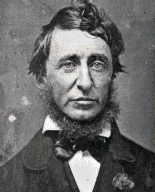
Henry David Thoreau was a bright youngster from an undistinguished family in Concord, Massachusetts, eventually graduating from Harvard. After only two weeks in a teaching job in a Concord school he returned to his father's pencil-making business, but a canoe trip in 1839 persuaded him that he was to be a poet of Nature rather than a schoolmaster. His friendship with Emerson helped him in this ambition, and his work was first published in the Transcendentalist magazine, The Dial. In 1854 Thoreau retreated to Walden Pond, on land owned by Emerson, and built a cabin there. He grew his own food and lived alone for two years, during which time he wrote the diary series now known as Walden. The following extracts give an idea of Thoreau's feel for Nature:
I found in myself, and still find, an instinct toward a higher, or, as it is named, spiritual life, as do most men, and another toward a primitive rank and savage one, and I reverence them both. I love the wild not less than the good. (Walden: Higher Laws)
This is a delicious evening, when the whole body is one sense, and imbibes delight through every pore. I go and come with a strange liberty in Nature, a part of herself. As I walk along the stony shore of the pond in my shirt-sleeves, though it is cool as well as cloudy and windy, and I see nothing special to attract me, all the elements are unusually congenial to me. The bullfrogs trump to usher in the night, and the note of the whip-poor-will is borne on the rippling wind from over the water. Sympathy with the fluttering alder and poplar leaves almost takes away my breath; yet, like the lake, my serenity is rippled but not ruffled. These small waves raised by the evening wind are as remote from storm as the smooth reflecting surface. Though it is now dark, the wind still blows and roars in the wood, the waves still dash, and some creatures lull the rest with their notes. The repose is never complete. The wildest animals do not repose, but seek their prey now; the fox, and skunk, and rabbit, now roam the fields and woods without fear. They are Nature's watchmen--links which connect the days of animated life. (Walden: Solitude)
The next extract touches on the issue of loneliness, an important one at some time or other in the spiritual life for most people, for some solitude seems essential to a grasp of the transcendent:
Yet I experienced sometimes that the most sweet and tender, the most innocent and encouraging society may be found in any natural object, even for the poor misanthrope and most melancholy man. There can be no very black melancholy to him who lives in the midst of Nature and has his senses still. There was never yet such a storm but it was Æolian music to a healthy and innocent ear. Nothing can rightly compel a simple and brave man to a vulgar sadness. While I enjoy the friendship of the seasons I trust that nothing can make life a burden to me. The gentle rain which waters my beans and keeps me in the house today is not drear and melancholy, but good for me too. Though it prevents my hoeing them, it is of far more worth than my hoeing. If it should continue so long as to cause the seeds to rot in the ground and destroy the potatoes in the low lands, it would still be good for the grass on the uplands, and, being good for the grass, it would be good for me. Sometimes, when I compare myself with other men, it seems as if I were more favored by the gods than they, beyond any deserts that I am conscious of; as if I had a warrant and surety at their hands which my fellows have not, and were especially guided and guarded. I do not flatter myself, but if it be possible they flatter me. I have never felt lonesome, or in the least oppressed by a sense of solitude, but once, and that was a few weeks after I came to the woods, when, for an hour, I doubted if the near neighborhood of man was not essential to a serene and healthy life. To be alone was something unpleasant. But I was at the same time conscious of a slight insanity in my mood, and seemed to foresee my recovery. In the midst of a gentle rain while these thoughts prevailed, I was suddenly sensible of such sweet and beneficent society in Nature, in the very pattering of the drops, and in every sound and sight around my house, an infinite and unaccountable friendliness all at once like an atmosphere sustaining me, as made the fancied advantages of human neighborhood insignificant, and I have never thought of them since. Every little pine needle expanded and swelled with sympathy and befriended me. I was so distinctly made aware of the presence of something kindred to me, even in scenes which we are accustomed to call wild and dreary, and also that the nearest of blood to me and humanest was not a person nor a villager, that I thought no place could ever be strange to me again. (Walden: Solitude)
Thoreau reflects further on solitude in the next extract by considering the 'witness' or witnessing consciousness:
With thinking we may be beside ourselves in a sane sense. By a conscious effort of the mind we can stand aloof from actions and their consequences; and all things, good and bad, go by us like a torrent. We are not wholly involved in Nature. I may be either the driftwood in the stream, or Indra in the sky looking down on it. I may be affected by a theatrical exhibition; on the other hand, I may not be affected by an actual event which appears to concern me much more. I only know myself as a human entity; the scene, so to speak, of thoughts and affections; and am sensible of a certain doubleness by which I can stand as remote from myself as from another. However intense my experience, I am conscious of the presence and criticism of a part of me, which, as it were, is not a part of me, but spectator, sharing no experience, but taking note of it, and that is no more I than it is you. When the play, it may be the tragedy, of life is over, the spectator goes his way. It was a kind of fiction, a work of the imagination only, so far as he was concerned. This doubleness may easily make us poor neighbors and friends sometimes. (Walden: Solitude)
Thoreau's idea of 'doublness' is an important element in the jnani experience, that there is an 'I' beyond our ordinary human self ('human entity'), that is the witness to all the drama of our life. We remember that Maharshi made a sudden leap of identification into the 'witness', leaving behind so thoroughly his 'human entity' that he nearly died. Thoreau has not gone so far, but has an insight into the destination. He also comments that this perspective can make one a 'poor neighbour and friend.' This is true of course in the secular life, but it is the very quality that makes one a good spiritual friend.
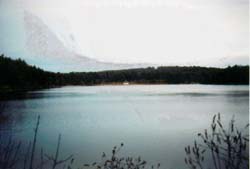 photo: Thoreau
Society
photo: Thoreau
Society
In this last extract Thoreau reveals his generosity, some would say his unworldliness, but at the same times tell us a little story of the via positiva:
My imagination carried me so far that I even had the refusal of several farms--the refusal was all I wanted--but I never got my fingers burned by actual possession. The nearest that I came to actual possession was when I bought the Hollowell place, and had begun to sort my seeds, and collected materials with which to make a wheelbarrow to carry it on or off with; but before the owner gave me a deed of it, his wife--every man has such a wife--changed her mind and wished to keep it, and he offered me ten dollars to release him. Now, to speak the truth, I had but ten cents in the world, and it surpassed my arithmetic to tell, if I was that man who had ten cents, or who had a farm, or ten dollars, or all together. However, I let him keep the ten dollars and the farm too, for I had carried it far enough; or rather, to be generous, I sold him the farm for just what I gave for it, and, as he was not a rich man, made him a present of ten dollars, and still had my ten cents, and seeds, and materials for a wheelbarrow left. I found thus that I had been a rich man without any damage to my poverty. But I retained the landscape, and I have since annually carried off what it yielded without a wheelbarrow. With respect to landscapes, "I am monarch of all I survey, My right there is none to dispute."
I have frequently seen a poet withdraw, having enjoyed the most valuable part of a farm, while the crusty farmer supposed that he had got a few wild apples only. Why, the owner does not know it for many years when a poet has put his farm in rhyme, the most admirable kind of invisible fence, has fairly impounded it, milked it, skimmed it, and got all the cream, and left the farmer only the skimmed milk. (Walden: Where I Lived, and What I Lived for)
To most of his Victorian contemporaries the idea that 'it surpassed his arithmetic' to tell whether he owned the farm, the ten cents, the ten dollars or all together, would simply confirm his status as idiot. But to us he is telling us what Traherne remarked upon at such length, that in a very real way he owned the farm and the landscape, and that he needs no wheelbarrow to carry off its annual harvest. He is all that he surveys, and nothing tells us more powerfully of what one is than Nature.
Whitman thought that Thoreau's love of Nature lay more in a dislike of Man, and it is true that Thoreau does not have such a high opinion of people and their occupations as does Whitman. But Thoreau may just have been a more solitary type, and we find that he shared with Whitman to some degree at least the ability to 'become' what he saw, a quality of the via positiva. Thoreau is more like Jefferies, and walked in the forests in a similar way, waiting for the transcendent moments to come upon him.
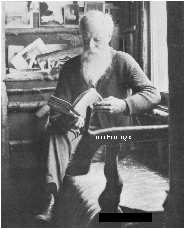 photo: John Burroughs Association
John Burroughs was a naturalist almost as well-known as John Muir, and did for birds and wildlife what Muir did for the wilderness in general. The 'EcoTopia/USA Ecology Hall of Fame' online project, dedicated to the heroes of the American environmental movement, says this about Burroughs:
John Burroughs earned his place in the Ecology Hall of Fame with a million and a half copies of his twenty three volumes of essays extolling nature and encouraging people to experience the natural world. While he wrote for adults, teachers found his work both challenging and interesting to students. Eleven schools were named for him; some still in operation. Known as the Hudson River naturalist and the father of the American nature essay, Burroughs became one of the most popular and respected authors of his time. At his rustic cabin, Slabsides, not far from the Hudson that he built with his son in 1895, Burroughs entertained many famous visitors in his later years. Theodore Roosevelt, Walt Whitman, Henry Ford and Thomas Edison came. Fellow Ecology Hall of Famer, John Muir, was a contemporary and friend.
Henry James called Burroughs "a more humorous, more available and more sociable Thoreau." Burroughs is of particular interest to as both naturalist and one of Whitman's biographers. Burroughs knew him initially through Leaves of Grass, and was nervous of him as 'poet of wickedness also'. On meeting him Burroughs says: 'I saw that the man and the work were one, and the the former must be as good as the latter was good.' In fact Whitman made a great impression on Burroughs, and on Whitman's deathbed Burroughs remarked: 'It is the face of an aged loving child. As I looked, it was with the reflection that, during an acquaintance of thirty-six years, I never heard from those lips a word of irritation, or depreciation of any being. I do not believe that Buddha, of whom he appeared an avatar, was more gentler to all men, women, children and living things.'
Burroughs found no trace of traditional religion in Whitman, saying 'Ecclesiasticism is dead'. 'In the past this ideal was found in the supernatural; for us and the future democratic ages, it must be found in the natural, in the now and the here.' Despite Burrough's very good instincts here about the spiritual life, and the thirty-six years of acquaintance with Whitman, he never made the leap of transcendent understanding that seems to lie behind both Muir's and Thoreau's writings, as we see here:
"I wish there were something to light up the grave for me, but there is not. It is the primal, unending darkness. The faith of all the saints and martyrs does not help me. I must see the light beyond with my own eyes. Whitman's indomitable faith I admire, but cannot share. My torch will not kindle at his great flame. From our youth up our associations with the dead and with the grave are oppressive. Our natural animal instincts get the better of us. Death seems the great catastrophe. The silver cord is loosened, and the golden bowl is broken. The physical aspects of death are unlovely and repellent. And the spiritual aspects—only the elect can see them. Our physical senses are so dominant, the visible world is so overpowering, that all else becomes as dreams and shadows.
I know that I am a part of the great cosmic system of things, and that all the material and all the forces that make up my being are as indestructible as the great Cosmos itself—all that is physical must remain in some form. But consciousness, the real Me, is not physical, but an effect of the physical. It is really no more a thing than "a child's curlicue cut by a burnt stick in the night," and as the one is evanescent, why not the other?
Nature is so opulent, so indifferent to that we hold most precious, such a spendthrift, evokes such wonders from such simple materials! Why should she conserve souls, when she has the original stuff of myriads of souls ? She takes up, and she lays down. Her cycles of change, of life and death, go on forever. She does not lay up stores; she is, and has, all stores, whether she keep or whether she waste. It is all the same to her. There is no outside, no beyond, to her processes and possessions. There is no future for her, only an everlasting present. What is the very bloom and fragrance of humanity to the Infinite? In the yesterday of geologic time, humanity was not. In the tomorrow of geologic time, it will not be. The very mountains might be made of souls, and all the stars of heaven kindled with souls, such is the wealth of Nature in what we deem so precious, and so indifferent is she to our standards of valuation.
This I know, too: that the grave is not dark or cold to the dead, but only to the living. The light of the eye, the warmth of the body, still exist undiminished in the universe, but in other relations, under other forms. Shall the flower complain because it fades and falls? It has to fall before the fruit can appear. But what is the fruit of the flower of human life? Surely not the grave, as the loose thinking of some seem to imply. The only fruit I can see is in fairer flowers, or a higher type of mind and life that follows in this world, and to which our lives may contribute. The flower of life has improved through the ages—the geologic ages; from the flower of the brute, it has become the flower of the man. You and I perish, but something goes out, or may go out, from us that will help forward a higher type of mankind. To what end? Who knows? We cannot crossquestion the Infinite. Something in the universe has eventuated in man, and something has profited by his ameliorations. We must regard him as a legitimate product, and we must look upon death as a legitimate part of the great cycle—an evil only from our temporary and personal point of view, but a good from the point of view of the whole." ... from Facing the Mystery, vol. 23, p. 285-288
When Burroughs says that his torch will not kindle at Whitman's great flame we can understand this from the perspective of the Master/Disciple relationship, and place it in the context of those that certainly did kindle, Richard Maurice Bucke in particular. Yet Burroughs' biography is curiously more authoritative than Bucke's, perhaps because Bucke is too clearly the disciple of this great, but misunderstood, Western guru. Nevertheless, Burroughs' musings on death in the extract above will be useful later on when we examine the more ambivalent attitudes to Nature in the late 20th century. In particular, he finds that he cannot 'crossquestion the Infinite', the very activity that is assumed by the jnani outlook and determination, but he has an accommodation with his personal death that seems much harder a century later.
In the meantime let us look at some genuinely inspired writings by Burroughs on Nature, in which we can again see the influence of Whitman on his thinking. Here is a meditation on Autumn:
THE FALLING LEAVES
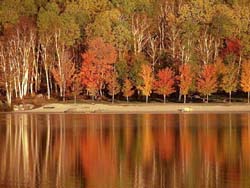 photo: John Burroughs Association
The carpet of the newly fallen leaves looks so clean and delicate when it first covers the paths and the highways that one almost hesitates to walk upon it. Was it the gallant Raleigh who threw down his cloak for Queen Elizabeth to walk upon? See what a robe the maples have thrown down for you and me to walk upon! How one hesitates to soil it! The summer robes of the groves and the forests — more than robes, a vital part of themselves, the myriad living nets with which they have captured, and through which they have absorbed, the energy of the solar rays. What a change when the leaves are gone, and what a change when they come again! A naked tree may be a dead tree. The dry, inert bark, the rough, wirelike twigs change but little from summer to winter. When the leaves come, what a transformation, what mobility, what sensitiveness, what expression! Ten thousand delicate veined hands reaching forth and waving a greeting to the air and light, making a union and compact with them, like a wedding ceremony. How young the old trees suddenly become! what suppleness and grace invest their branches! The leaves are a touch of immortal youth. As the cambium layer beneath the bark is the girdle of perennial youth, so the leaves are the facial expression of the same quality. The leaves have their day and die, but the last leaf that comes to the branch is as young as the first. The leaves and the blossom and the fruit of the tree come and go, yet they age not; under the magic touch of spring the miracle is repeated over and over.
Whitman's expression "the slumbering and liquid trees" often comes to my mind. They are the words of a poet who sees hidden relations and meanings everywhere. He knows how fluid and adaptive all animate nature is. The trees are wrapped in a kind of slumber in winter, and they are reservoirs of living currents in summer. If all living bodies came originally out of the sea, they brought a big dower of the sea with them. The human body is mainly a few pinches of earth salts held in solution by several gallons of water. The ashes of the living tree bulk small in comparison with the amount of water it holds. Yes, "the slumbering and liquid trees." They awaken from their slumber in the spring, the scales fall from their buds, the fountains within them are unsealed, and they again become streams of living energy, breaking into leaf and bloom and fruit under the magic of the sun's rays.
Burroughs, like the other writers here, can approach the joyousness of Jefferies in his prose, but is more inclined to also see Nature through the eyes of science. That he could not be kindled by Whitman's flame is the rule, not the exception, and we are grateful for the reminder that, despite the value of these three writers to Nature Mysticism, and hence to the jnani outlook, the fact is that it is Whitman that is the true spiritual jnani genius of nineteenth century America. We finish with one last quote from Burroughs:
"What I enjoy is commensurate with the earth and sky itself. It clings to the rocks and trees; it is kindred to the roughness and savagery: it rises from every tangle and chasm; it perches on the dry oak-stubs with the hawks and buzzards; the crows shed it from their wings and weave it into their nests of coarse sticks; the fox barks it; the cattle low it, and every mountain path leads to its haunts." From "Before Beauty" [Birds and Poets]
(The site author is indebted to the various on-line resources from which many of quotations and some of the images on this page have been taken. See Links.)